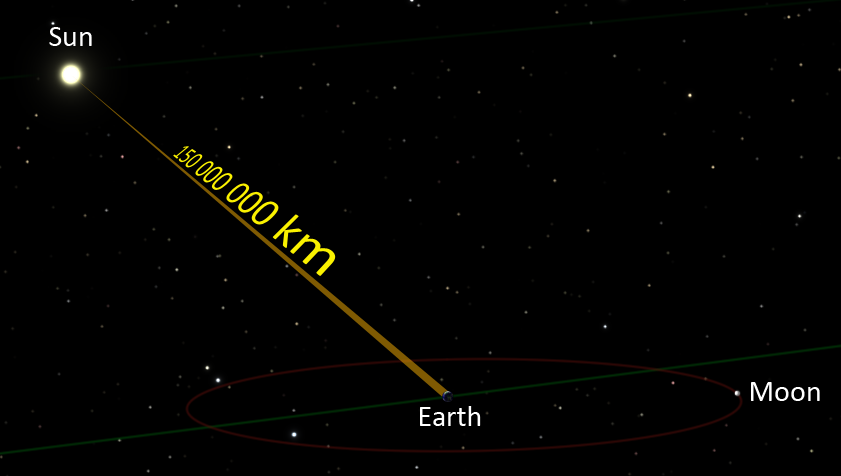
The speed of light in a vacuum is a fixed, fundamental constant of nature, equal to about 299,792 kilometres per second. It is the fastest speed at which anything can travel, and its constancy is among the best established facts in all of physics, confirmed by more than a century of ever more precise measurement.
For most of history, people assumed that light traveled instantly from place to place. The first real evidence otherwise came in 1676, when the astronomer Ole Rømer noticed that the eclipses of Jupiter's moons ran early or late depending on how far Jupiter was from Earth.
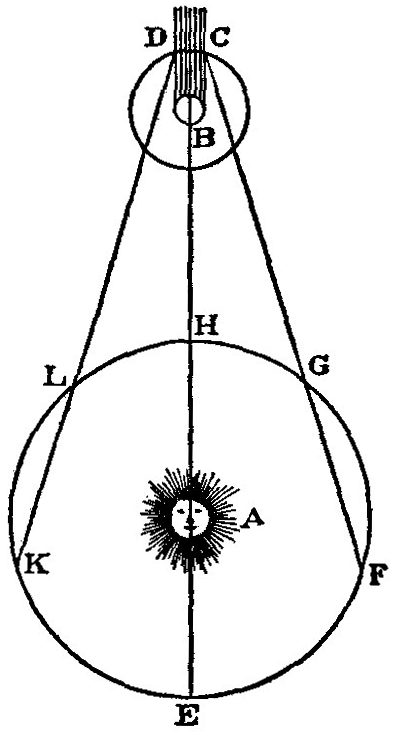
He correctly reasoned that the difference was the time light took to cross the changing distance, giving the first rough measurement of its speed.
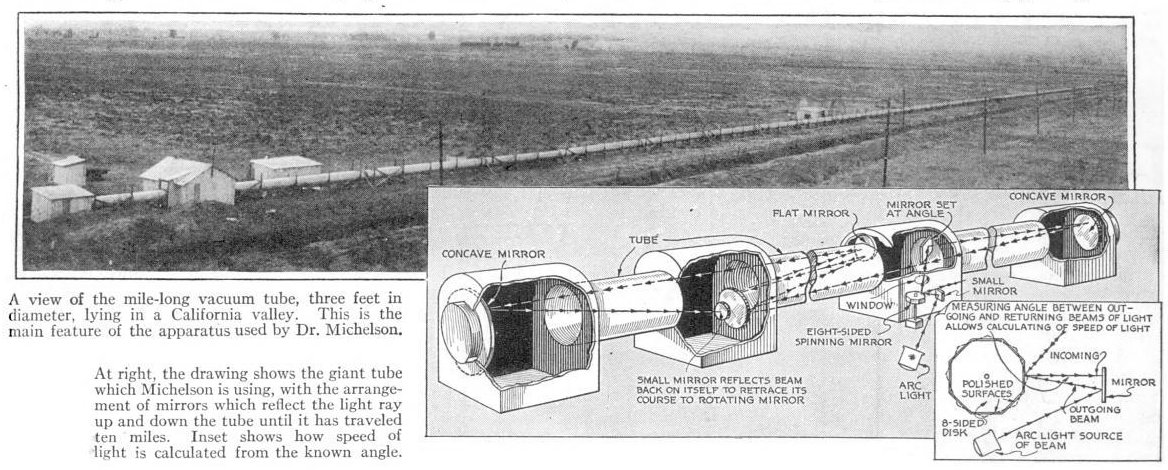
Over the following centuries, the value was measured with steadily greater precision. In the nineteenth and twentieth centuries, experimenters such as Albert Michelson used spinning mirrors and long, carefully surveyed distances to time light's passage, narrowing the figure to within a tiny fraction of its modern value.
A central insight of Einstein's relativity is that the speed of light is the same for every observer, no matter how fast they themselves are moving, and that nothing carrying energy or information can ever exceed it. This is not merely an assumption but a thoroughly tested fact, confirmed in particle accelerators and countless other experiments.
As an object is pushed faster, more and more of the energy poured into it goes into making it harder to accelerate, so that reaching the speed of light would require an infinite amount of energy. The cosmic speed limit is therefore built into the very fabric of space and time, not a barrier that better engineering could one day break.
Because light takes time to travel, looking out into space is also looking back in time. The Sun we see is the Sun of eight minutes ago, and the light from distant galaxies set out millions or billions of years before it reaches our telescopes, making the speed of light a kind of clock for the whole universe.
The speed of light appears far beyond the study of light itself. It sits at the centre of the famous equation relating energy and mass, and it links electricity and magnetism into a single unified force. Far more than the pace of a light beam, it is one of the deepest constants in the structure of reality.
The speed of light is now known so precisely, and trusted so completely, that it is used to define our units of length. Since 1983, the metre has been defined as the distance light travels in a tiny, exactly fixed fraction of a second. The constant is therefore no longer something we measure against a ruler; it is the ruler, a fixed reference point for all of science.
