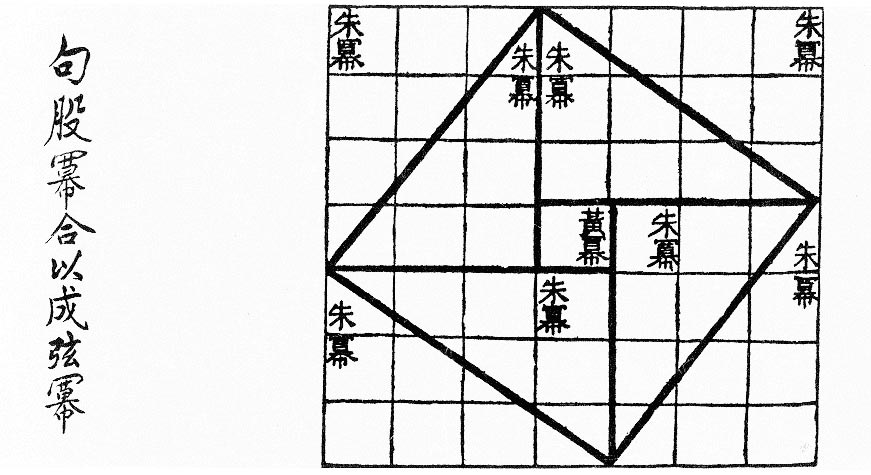
The Pythagorean theorem is one of the most famous results in all of mathematics. It states that in a right angled triangle, the square of the longest side, the hypotenuse, equals the sum of the squares of the other two sides. In symbols, a squared plus b squared equals c squared. Simple to state and endlessly useful, it has been known and trusted for thousands of years.
There is a crucial difference between a scientific theory and a mathematical theorem. A scientific theory is supported by evidence and could in principle be overturned by new data. A theorem is proven, shown by pure logic to follow with certainty from a set of starting assumptions, so that no future discovery could ever contradict it. Once a theorem is proven, it is settled for all time.
The Pythagorean theorem has been demonstrated in hundreds of distinct ways, by rearranging areas, by algebra, by similar triangles, and more. A whole book published in the early twentieth century collected hundreds of different proofs, and new ones are still devised today. Even a future president of the United States, James Garfield, published his own original proof. Every one of them shows that the relationship must hold for every right triangle, with no exception possible.
Although it is named after the Greek mathematician Pythagoras, who lived around 500 BC, the relationship itself was known to earlier civilizations. A Babylonian clay tablet known as Plimpton 322, created more than a thousand years before Pythagoras, already lists sets of whole numbers that satisfy the equation.
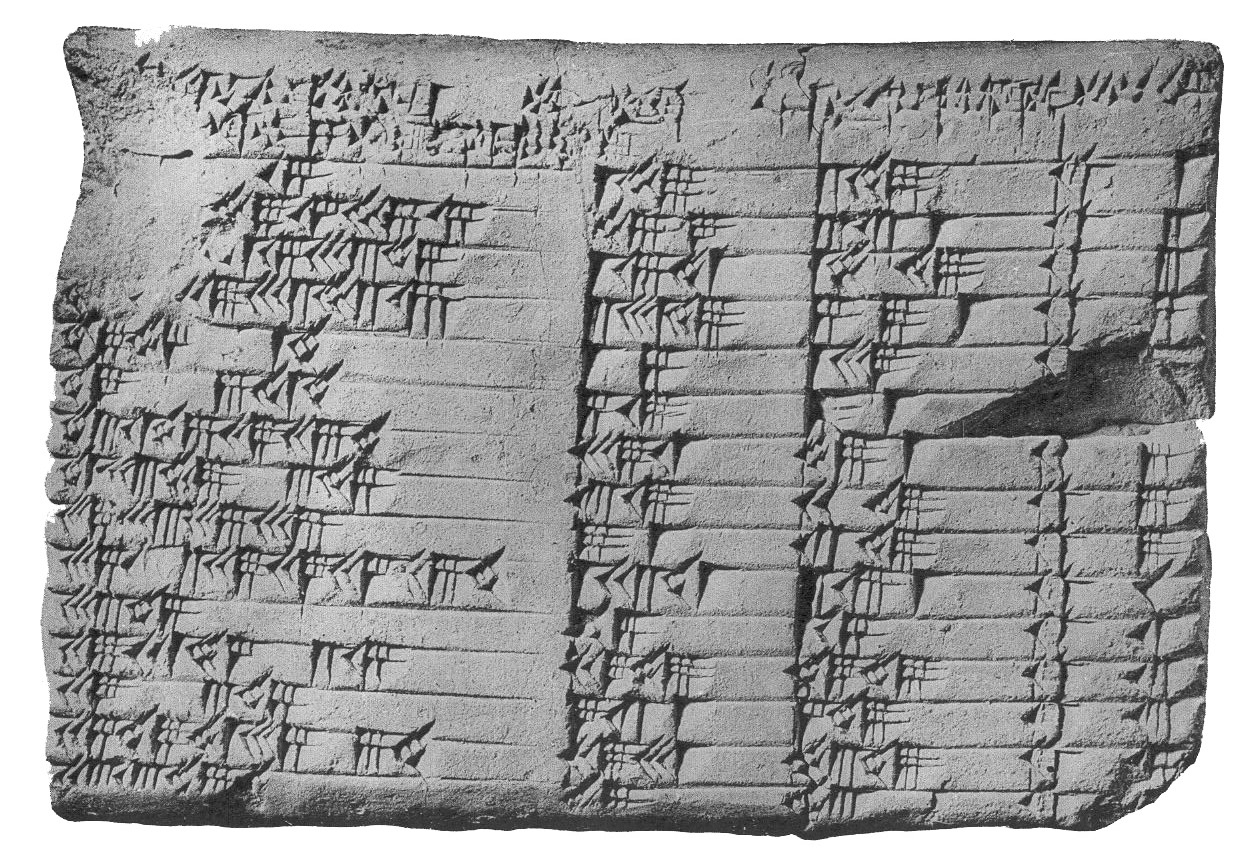
Evidence suggests the rule was understood and used independently in ancient Babylon, India, and China, long before the Greeks formalized it. Ancient builders used knotted ropes divided into lengths of three, four, and five units to lay out perfect right angles for fields and foundations, a practical trick that relies directly on the theorem.
Far from being a museum piece, the theorem is woven through everyday technology. It underlies the calculation of distances, the workings of navigation and satellite positioning, the geometry of computer graphics and screens, and the squaring of corners in construction. Any time a right angle and a straight line distance are involved, this ancient result is quietly doing its work.
The theorem also reaches deep into mathematics itself. It gives rise to the very notion of distance used in coordinate geometry, generalizes to three and more dimensions, and connects to trigonometry, complex numbers, and the geometry of curved spaces. It is one of the threads from which much of mathematics is woven.
More than two and a half thousand years after it was first proven, the Pythagorean theorem remains as reliable as the day it was established. It stands as a perfect example of what makes mathematics unique: a statement that, once proven, is true everywhere and forever, beyond the reach of any doubt.
