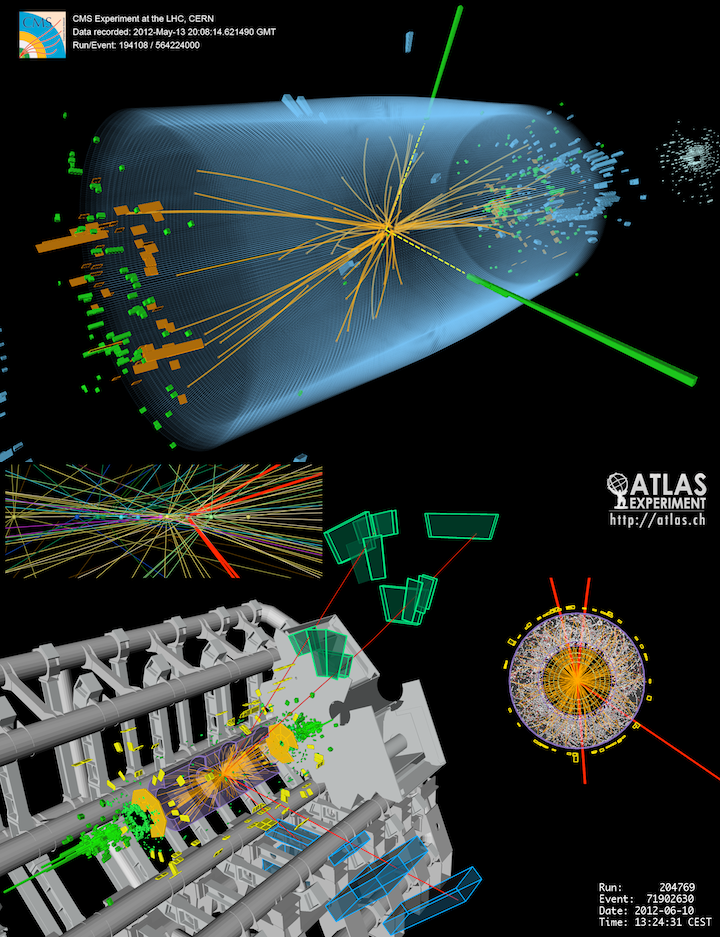
The Higgs boson is a fundamental particle whose discovery in 2012 confirmed how other particles acquire mass. Long predicted but famously hard to find, its detection was one of the greatest triumphs of modern physics.
Physics faced a deep puzzle: why do some particles have mass while others, like the particles of light, have none? Mass could not simply be assumed; the most successful theories worked only if particles started out massless. Something had to give them mass without breaking the elegant mathematics.
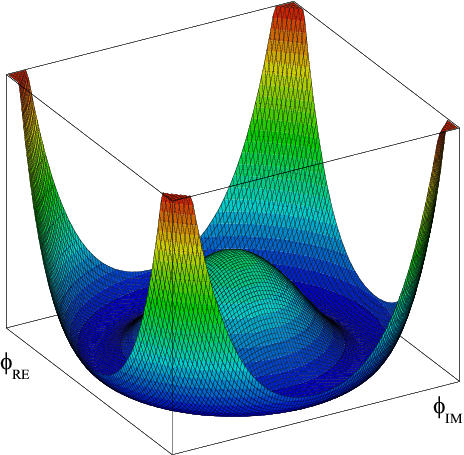
The answer, proposed in 1964 by Peter Higgs and several others, was that all of space is filled with an invisible field, now called the Higgs field. Particles gain mass by interacting with this field as they move through it, like objects dragging through a thick medium.
In this picture, particles that interact strongly with the Higgs field are heavy, while those that barely interact, like the photon, remain massless and travel at the speed of light. The field explains, in a single stroke, why the particles of nature have the particular masses they do.
According to quantum physics, every field has an associated particle, a ripple in the field. The Higgs field's particle is the Higgs boson. Finding it would be the way to prove the field is real, but the boson is heavy and fleeting, decaying almost instantly into other particles, making it extraordinarily hard to detect.
Confirming the Higgs required building the Large Hadron Collider, an enormous machine near Geneva that smashes protons together at nearly the speed of light. Out of these violent collisions, a Higgs boson might occasionally appear for an instant before decaying, leaving subtle traces for detectors to find.
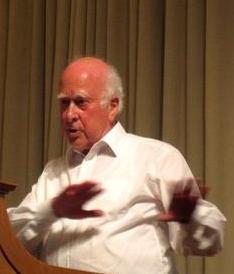
In 2012, two huge experiments at the collider, working independently, both spotted the telltale signs of a new particle with just the properties expected of the Higgs boson. The announcement was a global sensation, and Peter Higgs shared the Nobel Prize the following year for his decades old prediction.
The discovery filled the last missing piece of the Standard Model, the remarkably successful theory of the particles and forces that make up our world. It confirmed an idea that had stood unproven for nearly fifty years, and showed how the machinery of mass works at the deepest level of nature.
Physicists now study the Higgs boson closely, measuring its properties in detail. They hope it may point the way toward new physics beyond the Standard Model, perhaps offering clues to mysteries like dark matter. The particle that explains mass may yet open the door to even deeper discoveries.
