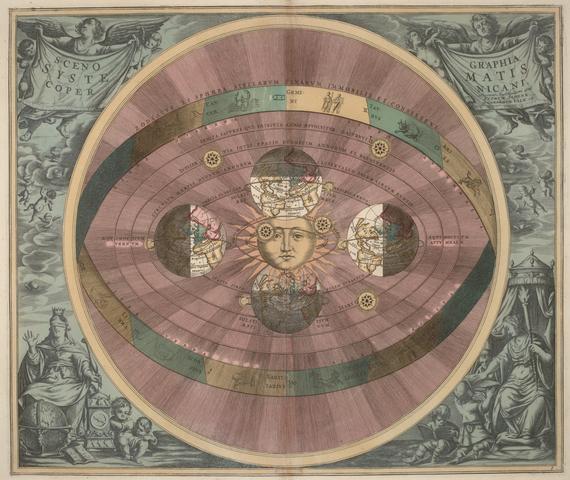
Heliocentrism is the understanding that the Earth and the other planets orbit the Sun, rather than the Sun and everything else orbiting the Earth. Once a radical and controversial claim, it is now established beyond any doubt and is the foundation of modern astronomy.
In the heliocentric model, the Sun sits near the centre of the Solar System, and the planets, including Earth, travel around it in orbits. The Earth also spins on its axis once a day. This rotation is what causes the Sun, Moon, and stars to appear to rise and set, even though it is we who are moving.
For most of history, people assumed the Earth stood still at the centre of the cosmos, and it is easy to see why. The ground feels motionless, and the heavens appear to wheel overhead. Our everyday senses suggest an unmoving Earth, which is part of why the truth was so hard to accept.
The ancient view, refined by the astronomer Ptolemy, placed Earth at the centre with everything circling it. To explain the odd, looping motions of the planets, it added complicated systems of circles upon circles. It worked well enough to predict the sky, and it reigned for over a thousand years.
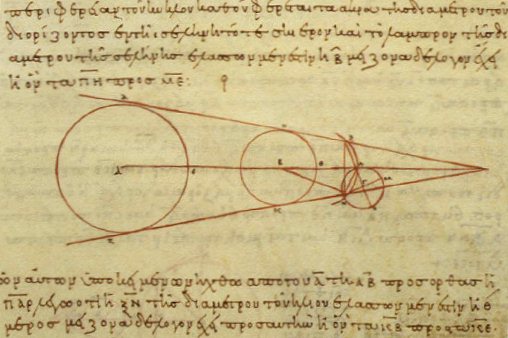
A few ancient thinkers, above all Aristarchus of Samos in the third century BC, suggested a Sun centred system and even tried to measure the sizes and distances of the Sun and Moon. But the idea did not take hold, partly because no one could feel the Earth moving and the supposed shift in the stars could not be detected.
In 1543 the Polish astronomer Nicolaus Copernicus revived heliocentrism with a detailed mathematical model, placing the Sun at the centre and the Earth among the planets. It was a bold challenge to both common sense and long standing authority, and it set off a revolution in how humanity saw its place in the cosmos.
Over the next century the case grew stronger. Johannes Kepler refined the orbits into ellipses, matching the observed motions with new precision. Galileo's telescope revealed moons circling Jupiter, proving not everything orbits Earth, and the phases of Venus, which only make sense if it orbits the Sun.
What began as a bold hypothesis is now confirmed by overwhelming evidence. The phases of Venus, the moons of other planets, and the tiny shifts in the positions of stars as Earth moves all fit the heliocentric model and rule out a stationary Earth. Centuries of ever more precise observation agree.
The ultimate confirmation is that we now navigate the Solar System using these very laws. Spacecraft travel to other planets, slingshot around moons, and rendezvous with comets using calculations built on the heliocentric model and Newton's laws of motion, arriving with pinpoint accuracy after journeys of billions of kilometres.
Heliocentrism stands as one of the great triumphs of science, a case where careful observation and reasoning overturned what once seemed obvious. It dethroned the Earth from the centre of creation and began the long process by which science has reshaped our understanding of the universe and our place within it.
