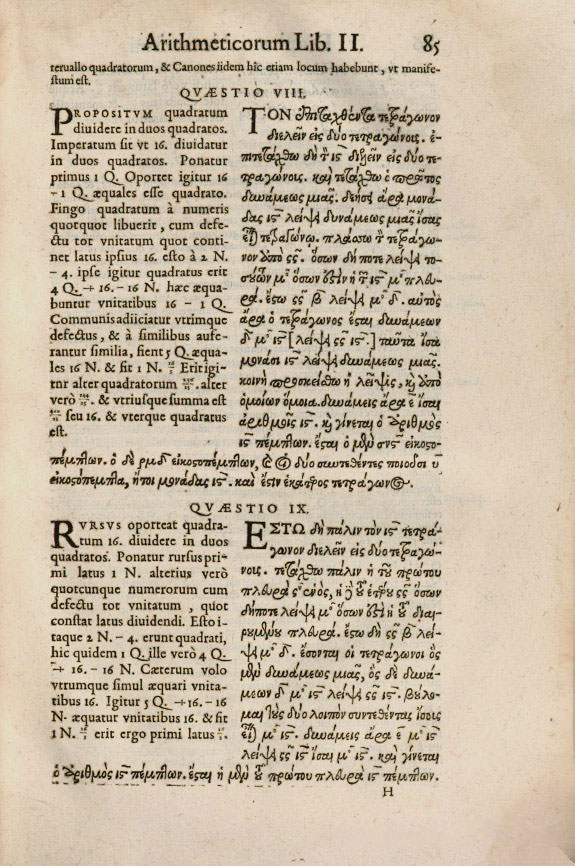
Fermat's Last Theorem states that no three positive whole numbers can satisfy the equation a to the power n, plus b to the power n, equals c to the power n, for any whole number n greater than two. It is simple enough for a schoolchild to understand, yet it resisted proof for more than three hundred and fifty years, becoming the most famous unsolved problem in mathematics.
For the power of two, the equation is just the Pythagorean theorem, and it has endless whole number solutions, such as three, four, and five. Fermat's claim was that the moment the power rises to three or beyond, all such solutions vanish completely. That so small a change could make every solution disappear is part of what made the problem so tantalizing.
Around 1637, the French mathematician Pierre de Fermat scribbled the claim in the margin of a book, adding the tantalizing remark that he had discovered a marvelous proof which the margin was too small to contain.
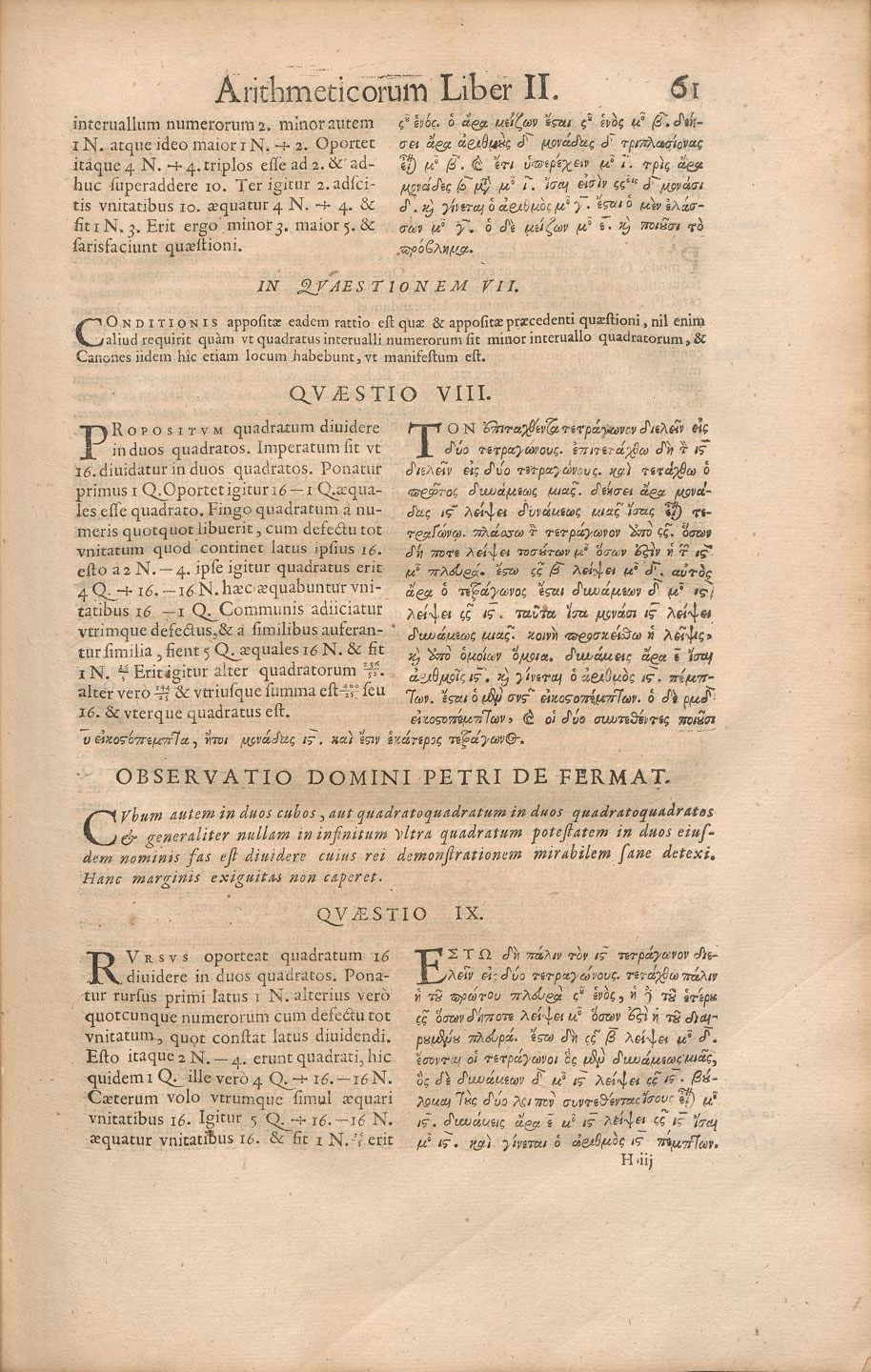
No such proof was ever found among his papers after his death, and few historians believe he truly had one. His teasing note launched a hunt that would occupy mathematicians for centuries.
Generations of the greatest mathematicians chipped away at the problem, proving it for particular values of n but never for all of them at once. Euler handled the power of three, others the powers of five and seven, and the search drove the creation of whole new areas of mathematics, yet a general proof stayed out of reach.
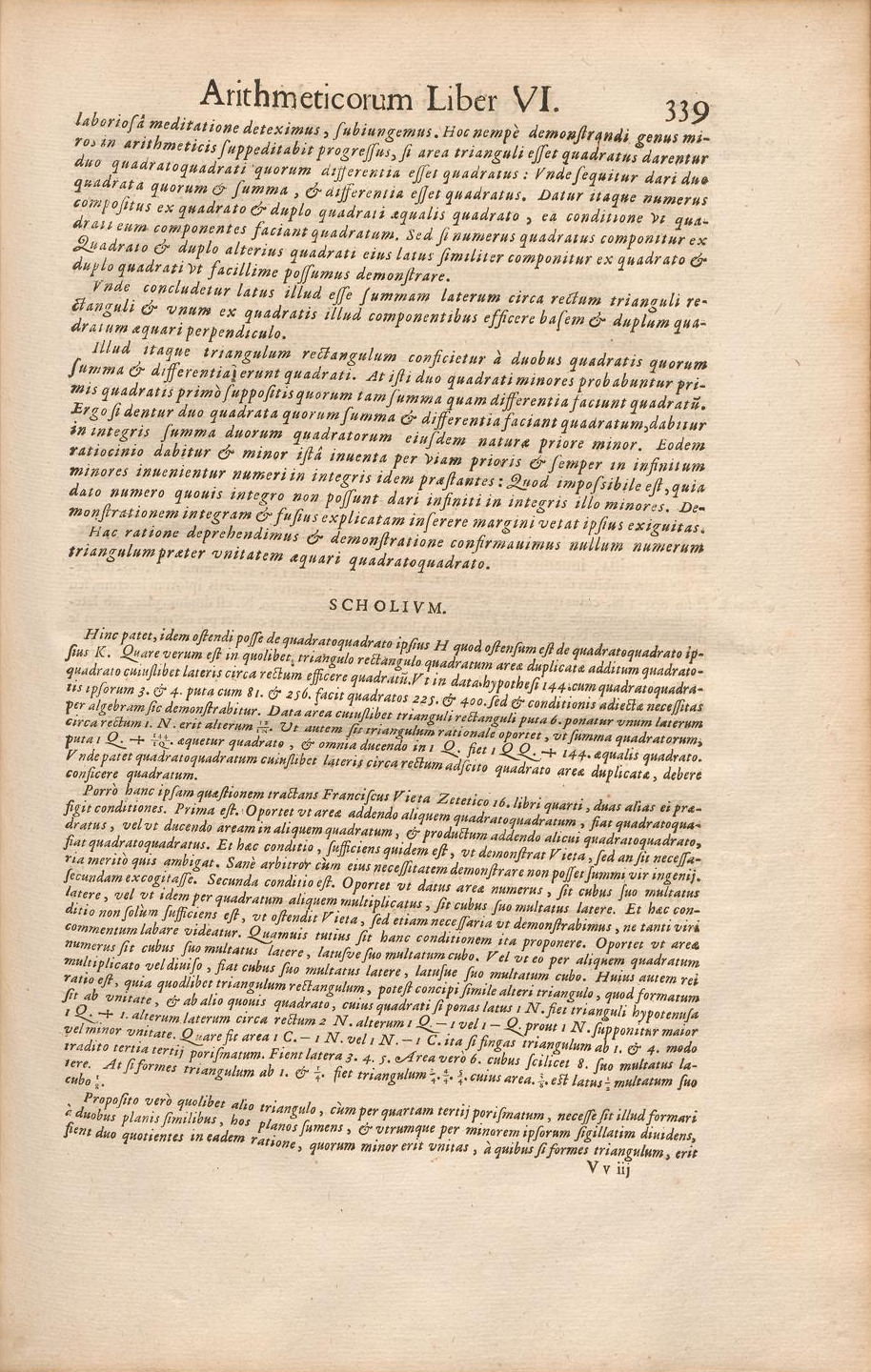
Fermat did leave behind a genuine proof for one case, the power of four, using a clever technique he called infinite descent, which shows that any solution would imply a smaller one, and a smaller one again, forever, which is impossible in whole numbers.
The complete proof finally arrived in 1994, from the British mathematician Andrew Wiles, who worked on it largely in secret for seven years. It runs to more than a hundred pages and draws on deep, modern mathematics far beyond anything Fermat could have known, connecting the problem to the theory of elliptic curves.
When a gap was found in Wiles's first announcement, a tense year of repair followed, during which many feared the proof would collapse. Working with a former student, Wiles finally bridged the gap, and the corrected proof was confirmed, ending the longest running puzzle in mathematics.
The centuries long search was never wasted effort. The attempts gave rise to entirely new branches of mathematics, and Wiles's proof forged unexpected links between distant fields. Fermat's Last Theorem endures as a celebrated reminder that a question a child can grasp may demand the most advanced tools humanity has ever built, and that in mathematics, once something is truly proven, it is settled forever.
