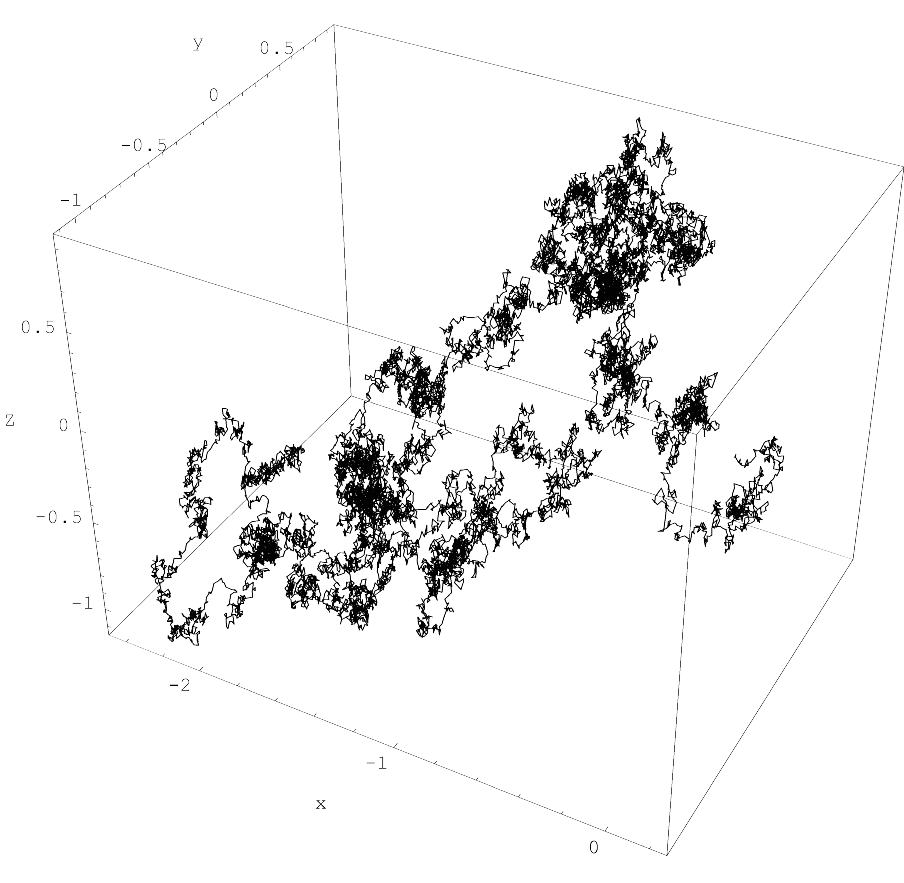
Brownian motion is the random, jittery movement of tiny particles suspended in a fluid, caused by their constant bombardment by the fluid's molecules. Once a curiosity seen under the microscope, it became decisive proof that matter is made of atoms.
In 1827, the botanist Robert Brown noticed that pollen grains floating in water trembled and wandered ceaselessly, with no living cause. The same restless motion appears for any small enough particle in a liquid or gas, jiggling and drifting in a way that seems to come from nowhere.
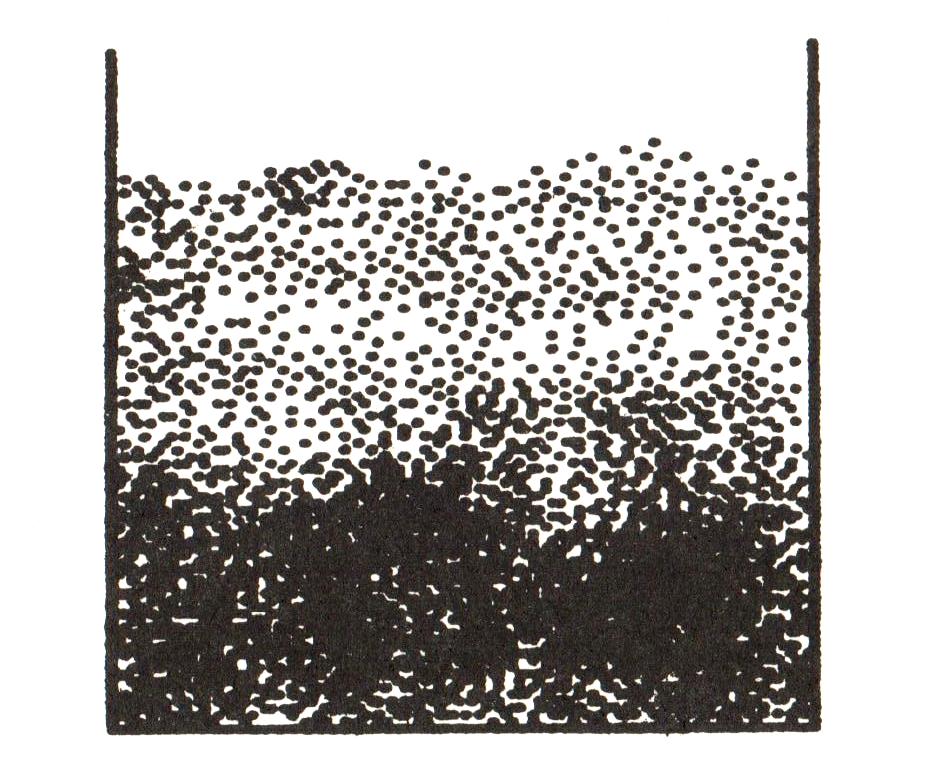
For decades the cause was a mystery. The particles seemed to move on their own, without being pushed by anything visible, and no one could explain what kept them in perpetual motion. Some wondered if it was a sign of life, until the same dance was seen in clearly non living dust.
The true cause is invisible. The particle, though tiny, is enormous compared with the molecules of the fluid around it. These molecules, in ceaseless motion, strike it from all sides countless times each instant. Usually the blows roughly cancel, but at any moment they are slightly unbalanced, nudging the particle this way and that.
In 1905, Albert Einstein explained the effect mathematically. He showed how the random molecular bombardment would make the visible particle wander, and he turned this picture into precise, testable predictions about how far a particle should drift over a given time, linking the motion to the size and number of molecules.
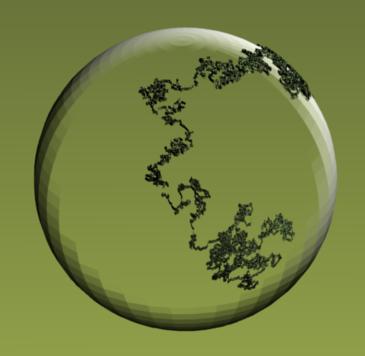
A few years later, the physicist Jean Perrin carried out careful experiments to test Einstein's formulas. By tracking the motion of particles under the microscope and measuring their wandering, he found exact agreement with the predictions, and could even calculate the number of molecules in a given amount of substance.
The agreement between theory and experiment was a triumph, because it could only be explained if matter really is made of molecules in constant motion. This finally convinced the last doubters that atoms exist, a question still genuinely open among some scientists at the start of the twentieth century.
Brownian motion became a foundational concept far beyond its origins. It is the classic example of a random process, and the mathematics developed to describe it underlies the study of diffusion, of noise in physical systems, and of randomness in general.
The same mathematics that describes a jiggling pollen grain is used to model the spread of heat, the diffusion of chemicals, and even the unpredictable movement of prices in financial markets. A humble observation under the microscope grew into a powerful tool reaching across science and beyond.
