Thermodynamics is the branch of physics concerned with heat, energy, and work, and how they transform from one form to another. Its laws are among the most universal in all of science, applying to everything from engines and refrigerators to stars and living cells.
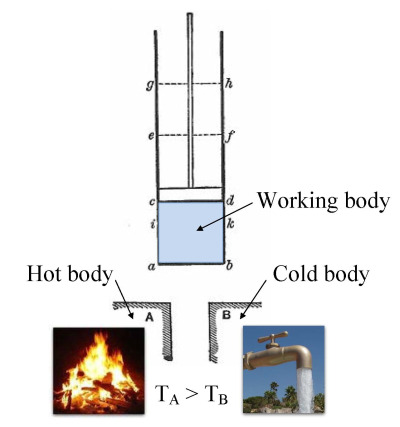
Thermodynamics studies how energy moves and changes form. Heat is energy flowing from a hotter object to a cooler one, and work is energy used to push, lift, or move something. A central insight is that heat and work are interchangeable forms of the same underlying quantity, energy, which can be converted but never conjured from nothing.
Temperature measures how hot or cold something is, and more precisely how fast its particles are jiggling. The so called zeroth law states that if two objects are each in balance with a third, they are in balance with each other, which is what makes a thermometer meaningful and lets us compare temperatures at all.
The first law of thermodynamics is the conservation of energy: energy can be neither created nor destroyed, only converted from one form to another. The total energy of an isolated system stays constant. This rules out any machine that produces energy from nowhere, and it lets engineers track exactly where energy goes.
The second law states that disorder, measured by a quantity called entropy, always tends to increase in an isolated system. This is why heat flows from hot to cold and never spontaneously the other way, why engines can never be perfectly efficient, and why some energy is always lost as useless waste heat.
The relentless increase of entropy gives time its direction. We remember the past and not the future, and broken cups never reassemble, because ordered states naturally give way to disordered ones. This humble statistical law underlies our deepest sense that time flows one way.
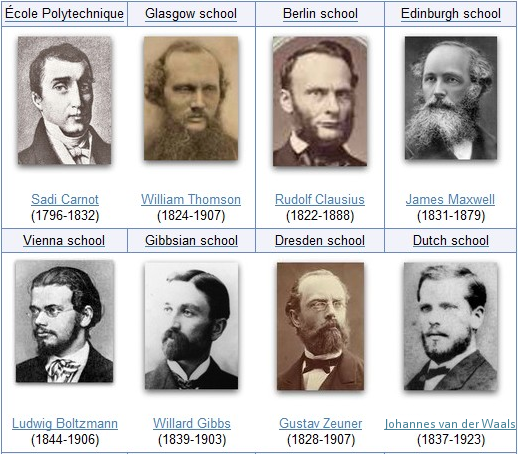
Thermodynamics grew out of a very practical problem: how to get the most work from the steam engines that powered the Industrial Revolution. In the 1820s the French engineer Sadi Carnot analysed the ideal engine and discovered fundamental limits on efficiency, founding the science almost single handed.
Over the following decades, scientists including Rudolf Clausius, Lord Kelvin, and Ludwig Boltzmann developed the concepts of energy and entropy with mathematical precision. Boltzmann showed that entropy is really a measure of the number of ways the particles of a system can be arranged, linking heat to the hidden motion of atoms.
The reach of thermodynamics is extraordinary. It governs power plants, engines, and refrigerators, explains why perpetual motion machines are impossible, and describes chemical reactions, the behaviour of gases, and the flow of energy through living things. On the grandest scale, it even shapes the long term fate of the universe. Few sets of ideas are so practical and so cosmic at once.
