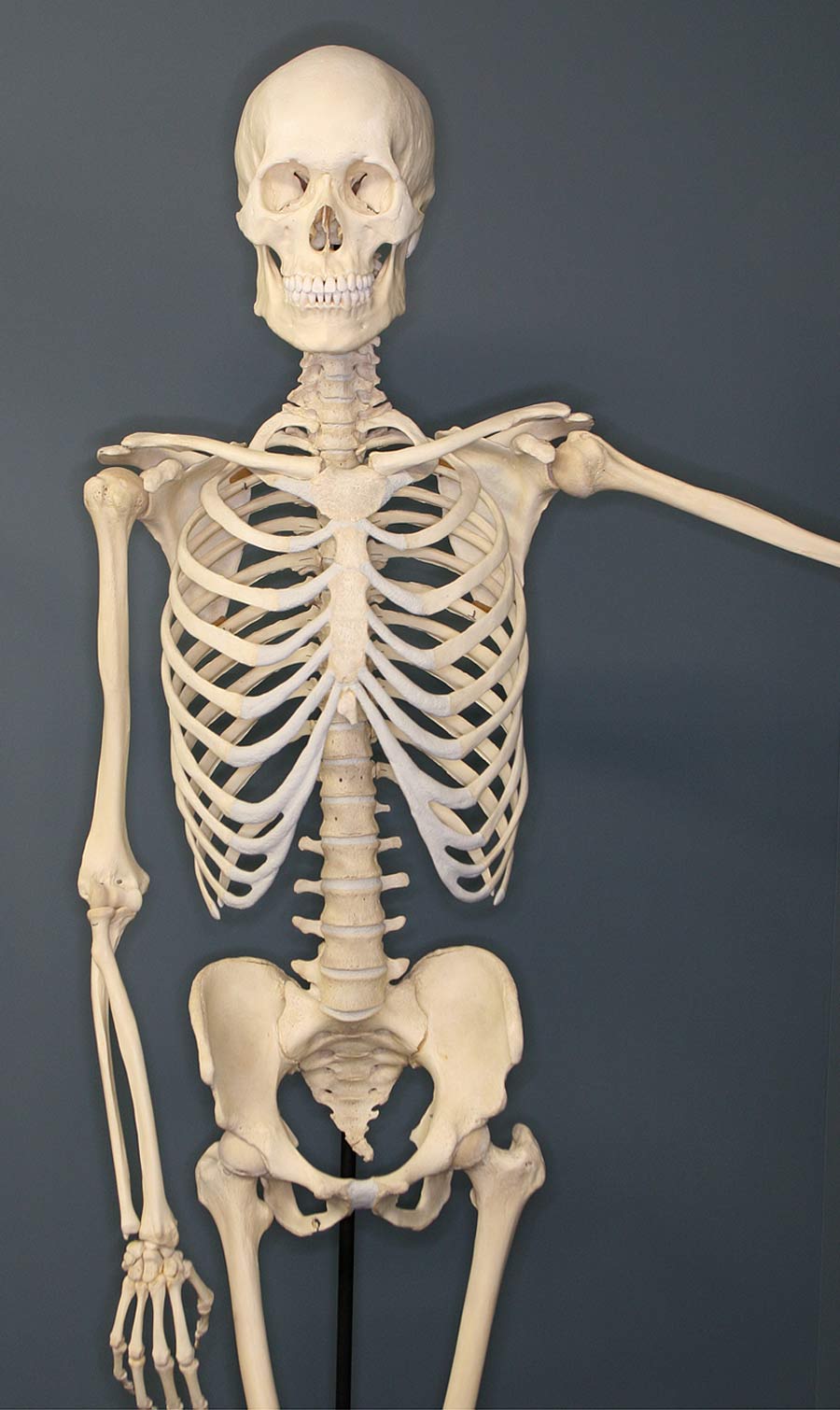
The human skeleton is the internal framework of bones that supports the body, protects its organs, and allows it to move. An adult skeleton has 206 bones, forming an elegant structure that is both strong and surprisingly light.
The skeleton gives the body its shape and holds it upright, providing the rigid scaffold against which muscles pull. Without it we would collapse into a shapeless heap. From the tiny bones of the inner ear to the long bones of the leg, each is shaped precisely for its role.
Bone is remarkably strong for its weight, comparable to steel in some respects yet far lighter, thanks to its clever structure of dense outer layers and a lighter, honeycombed interior. This combination lets the skeleton bear great loads, absorb shocks, and still be light enough for us to move with ease.
The skeleton shields the body's most delicate organs. The skull is a hard case guarding the brain, the ribcage forms a protective basket around the heart and lungs, and the spine encloses the vital spinal cord. Bone stands between these soft, irreplaceable tissues and the knocks of the outside world.
Far from a dead scaffold, bone is living tissue, laced with blood vessels and nerves and constantly being broken down and rebuilt. This allows it to heal after fractures, to grow as we grow, and to strengthen in response to exercise. A bone is as alive as any other part of the body.
Inside many bones lies soft marrow, where the body manufactures its blood cells, churning out millions every second. Bones also serve as a store of vital minerals, especially calcium and phosphorus, which the body draws on when it needs them, making the skeleton a chemical reservoir as well as a frame.
Where bones meet, joints allow movement, cushioned by smooth cartilage and bound by tough ligaments. Different joints permit different motions, from the simple hinge of the elbow to the free swivel of the ball and socket hip. Muscles, anchored to the bones, pull on this jointed framework to move the body.
A newborn baby actually has around 300 bones, many of them soft and separate, which gradually fuse and harden as the child grows, leaving the adult total of 206. The skeleton changes throughout life, reaching peak strength in youth and, in later years, often losing density and becoming more fragile.
Keeping bones healthy depends on good nutrition, especially calcium and vitamin D, and on regular exercise, which signals the bones to stay strong. With age or illness, bones can weaken, a condition called osteoporosis that makes fractures more likely. The skeleton, a dynamic living system, remains at the very core of the body.
