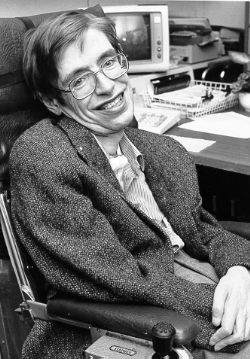
Stephen Hawking (1942 to 2018) was a British theoretical physicist who became one of the most famous scientists of his time, renowned for his work on black holes and the universe and for his triumph over severe disability.
Hawking studied physics at Oxford and then cosmology at Cambridge, showing exceptional brilliance from an early age, though by his own account he was a somewhat lazy student until his studies caught fire. He was drawn to the biggest questions of all, about the origin and fate of the universe itself.

At twenty one, Hawking was diagnosed with a form of motor neurone disease and told he had only a few years to live. The illness gradually paralysed his body over the following decades, confining him to a wheelchair and eventually robbing him of speech, so that he communicated through a computerized voice synthesizer.
Defying his prognosis, Hawking lived and worked for more than half a century after his diagnosis. Unable to write or even speak normally, he carried out his physics largely in his head, manipulating complex ideas through sheer mental power. His survival and productivity became a symbol of the resilience of the human mind.
Hawking's most celebrated discovery concerned black holes, the regions of space whose gravity is so strong that nothing, not even light, can escape. He showed that black holes are not completely black: they slowly emit radiation, now called Hawking radiation, and can in principle evaporate over immense time, a startling and profound result.
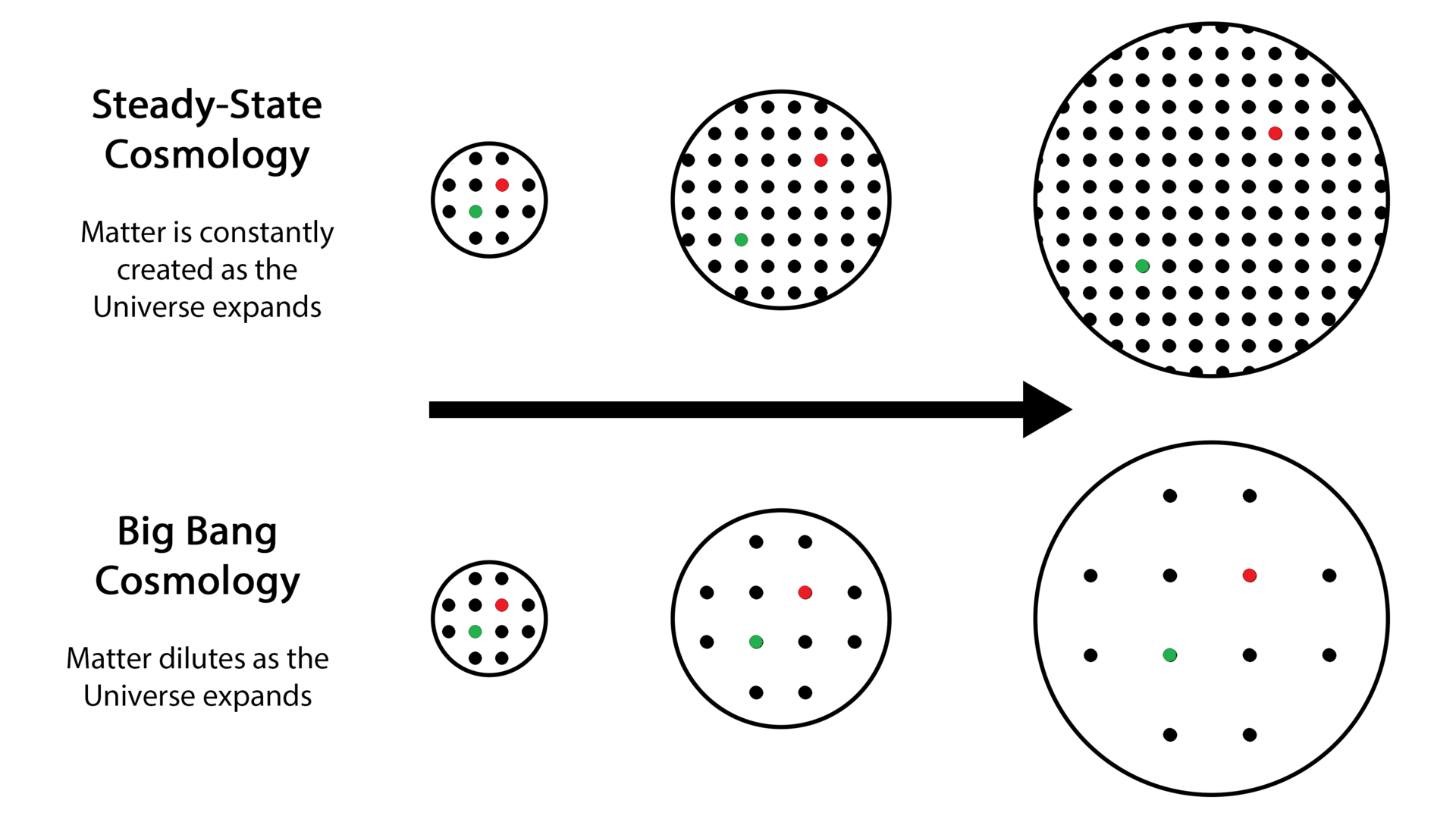
Hawking also worked on the very beginning of the universe, seeking to understand the Big Bang by combining the physics of the very large, Einstein's relativity, with that of the very small, quantum mechanics. His work probed whether the universe had a beginning in time and what its initial conditions might have been.
Hawking became a brilliant popularizer of science. His 1988 book A Brief History of Time, which explained ideas about time, black holes, and the universe for a general audience, sold millions of copies and became a publishing phenomenon, making him a household name far beyond the world of physics.
With his distinctive synthesized voice, his sharp humour, and his remarkable story, Hawking became a global cultural figure, appearing in television shows and films and lending his voice to popular culture. He was admired not only as a scientist but as an inspiring human being who refused to be defined by his disability.
Hawking died in 2018, having far outlived his original prognosis and having made lasting contributions to our understanding of the cosmos. He is remembered as a great scientist who illuminated the deepest questions about the universe, and as a symbol of the power of the mind to soar even when the body is bound.
