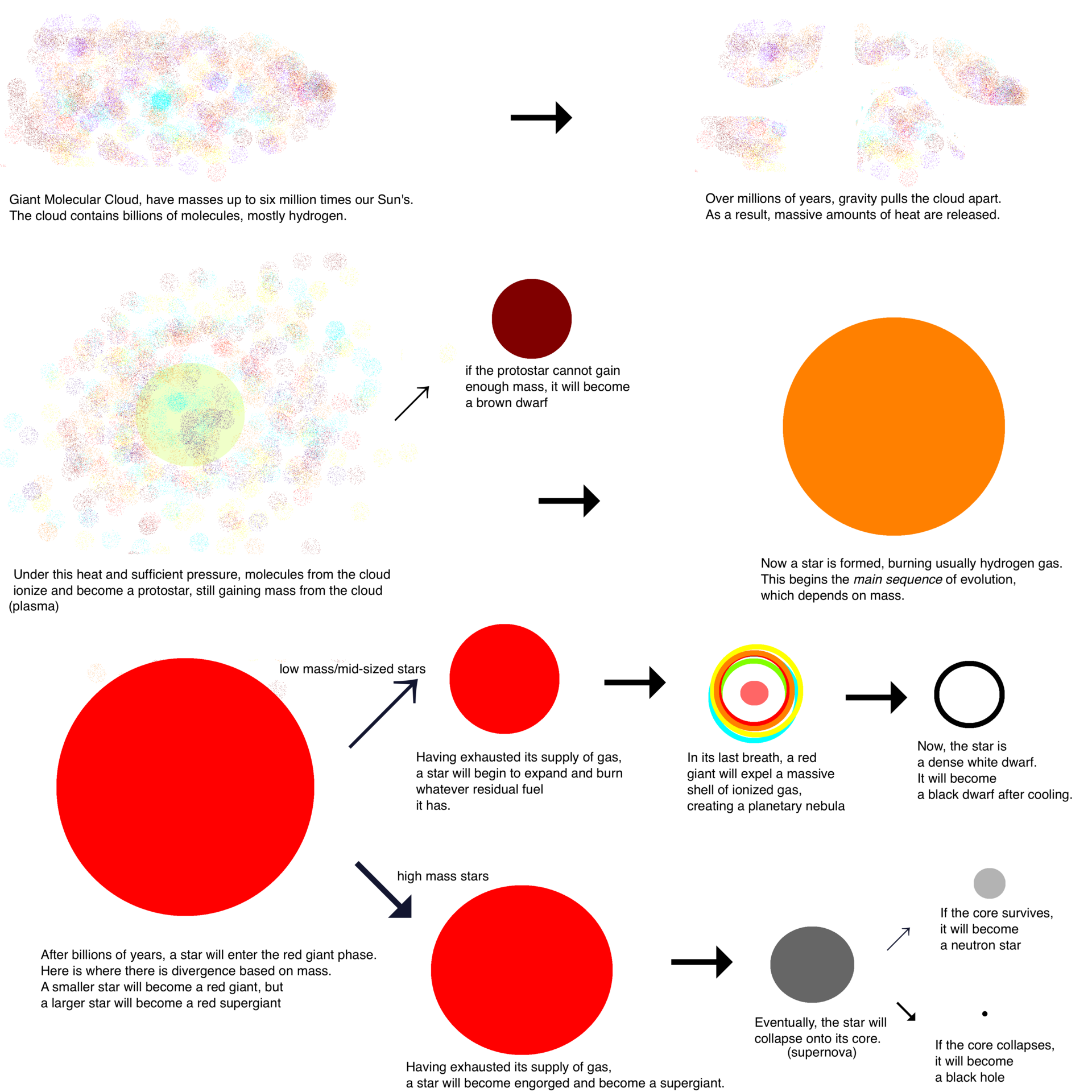
Stellar evolution is the scientific account of how stars are born, live, and die over millions or billions of years. Though no one can watch a single star through its whole life, the theory pieces the story together from the vast variety of stars seen across the sky.
A star is born when a vast cloud of gas and dust collapses under its own gravity. As the material falls inward it heats up, until the core grows hot and dense enough to ignite nuclear fusion, fusing hydrogen into helium and releasing enormous energy. At that moment, a new star begins to shine.
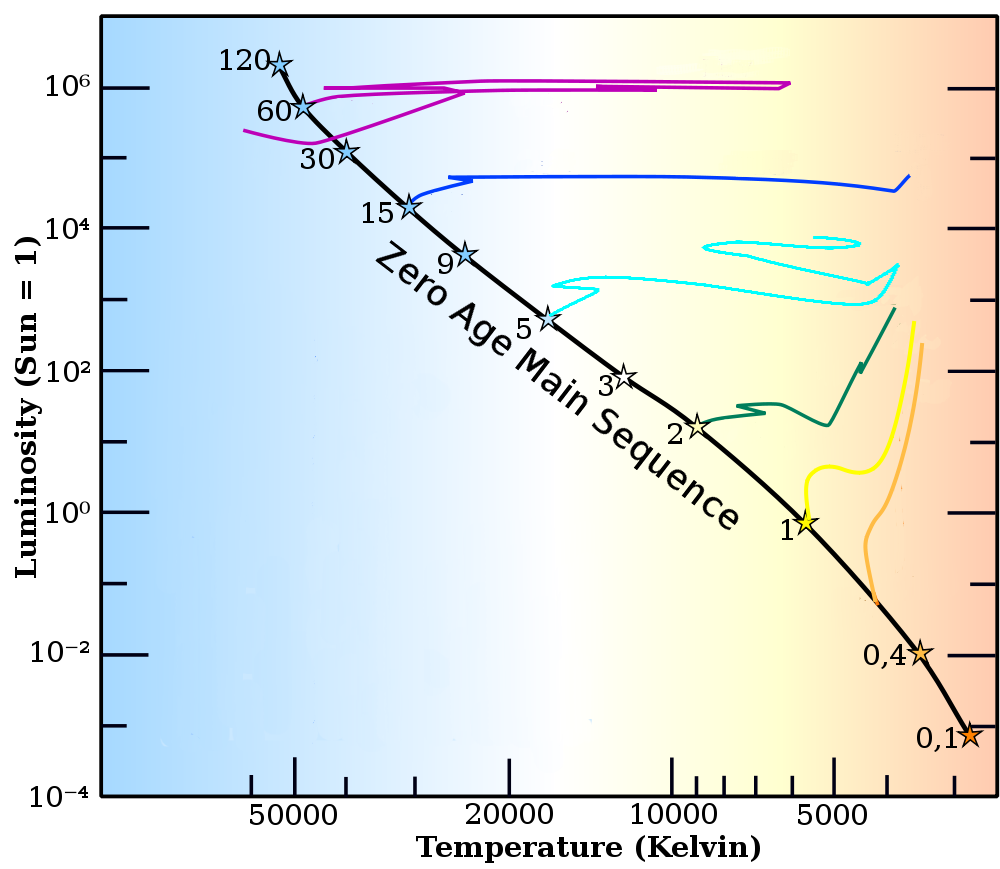
For most of its life a star is in balance: the inward pull of gravity is exactly offset by the outward push of energy from fusion in its core. This stable phase, in which the star steadily burns hydrogen, lasts the longest of any stage. Our Sun is in this phase now, and will be for billions of years more.
How a star lives and dies depends above all on its mass. Small stars burn slowly and live for tens of billions of years. Massive stars blaze furiously, exhausting their fuel in just a few million years and ending their lives in spectacular fashion. A star's mass at birth largely seals its fate.
Because stars live far longer than civilizations, astronomers cannot follow one through its life. Instead they observe many stars at different stages and use physics to connect them, much as one might infer the life cycle of a tree by studying a whole forest at once, seeing seedlings, mature trees, and fallen logs together.
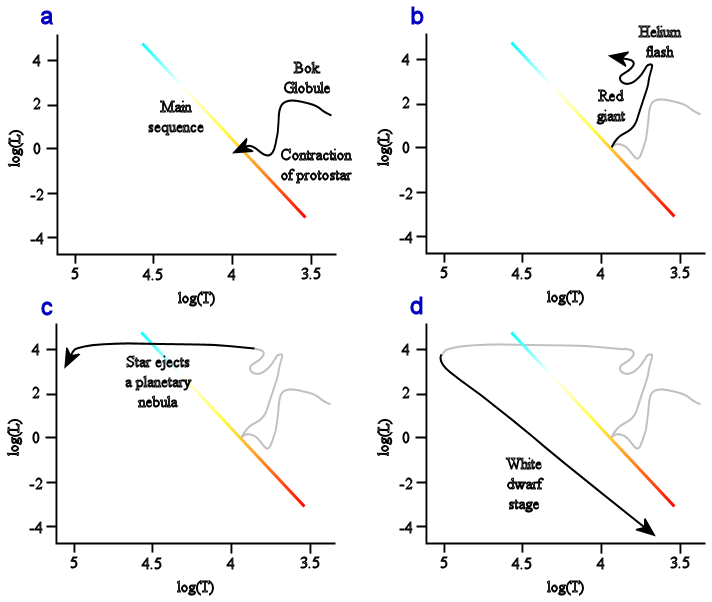
A famous chart, plotting stars by their brightness and colour, reveals the stages of stellar life and confirms the theory. Most stars fall along a band called the main sequence, while giants, dwarfs, and dying stars occupy their own regions. The diagram is a kind of map of stellar evolution.
A modest star like the Sun, as it runs low on hydrogen, will swell into a vast red giant, then gently shed its outer layers into space, leaving behind a small, dense, slowly cooling ember called a white dwarf. It is a quiet, drawn out ending, fading over billions of years.
A massive star dies violently. When its core can no longer support it, the star collapses and rebounds in a titanic explosion called a supernova, briefly outshining a whole galaxy. What remains is an ultra dense neutron star or, for the heaviest stars, a black hole from which not even light escapes.
The deaths of stars are not only endings but beginnings. The fusion within stars, and the violence of supernovae, forge the heavy elements, the carbon, oxygen, iron, and gold, and scatter them across space. From this enriched material, new stars, planets, and ultimately we ourselves are made. We are, quite literally, made of stardust.
