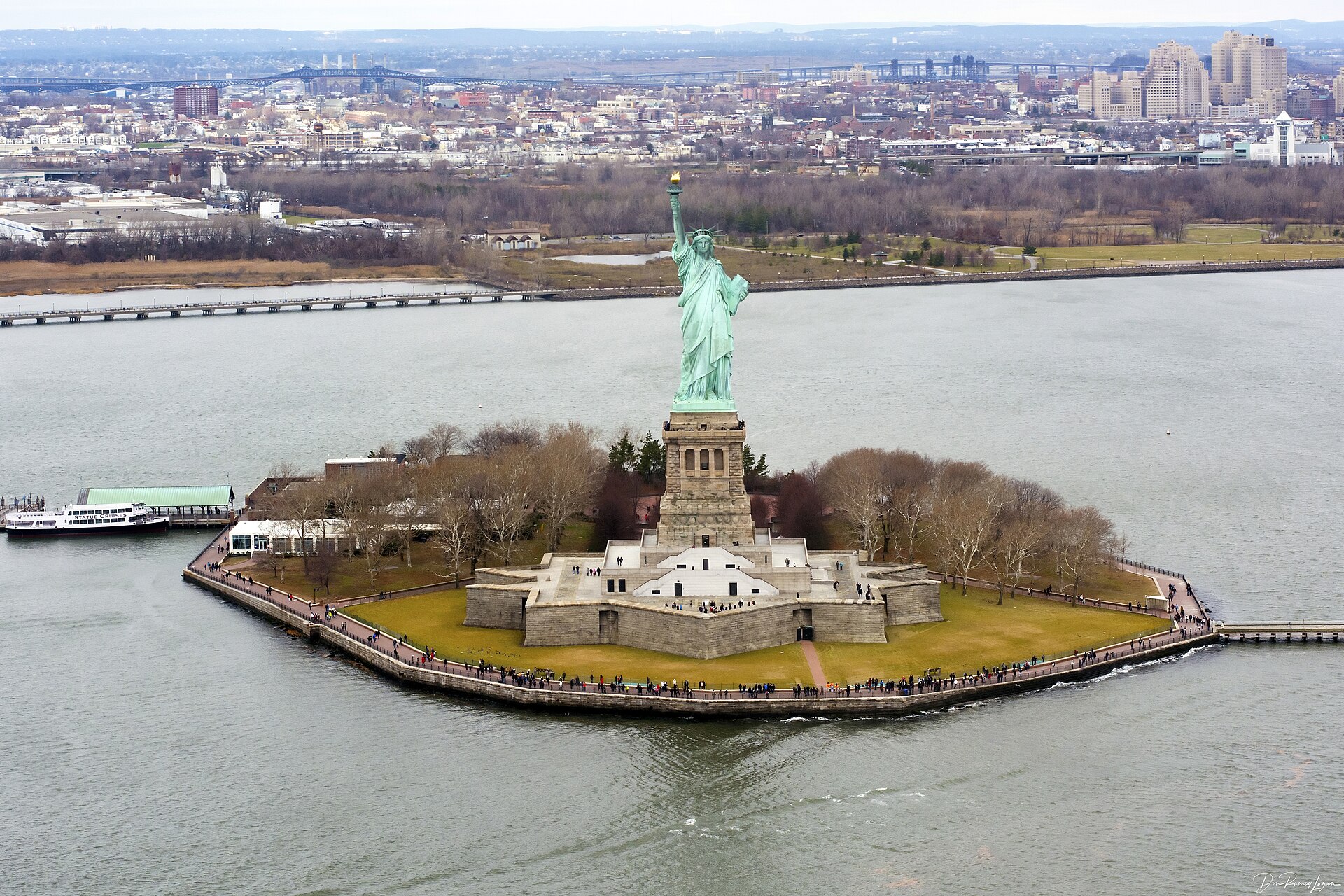
The Statue of Liberty is a colossal copper statue on an island in New York Harbor, one of the most famous monuments in the United States and a worldwide symbol of freedom and welcome. A gift from the people of France, it has greeted ships arriving in New York for well over a century.
The statue was conceived in France as a gift to the United States, a gesture of friendship between the two republics and a celebration of liberty. France funded the statue itself, while the United States raised money for the pedestal on which it stands, a collaboration that became a symbol of the bond between the two countries.
The French sculptor Frédéric Auguste Bartholdi designed the figure: a robed woman, the Roman goddess of liberty, holding a torch aloft and a tablet inscribed with the date of American independence, with broken chains at her feet symbolising freedom from oppression. Bartholdi was a master of the colossal, and the Statue of Liberty was the grandest of several monumental works he created.
The figure draws on a long tradition of personifying liberty as a woman, an idea reaching back to the ancient world and revived in the art of the eighteenth and nineteenth centuries. By giving that idea a torch and a tablet of law, Bartholdi turned an old symbol into something new: liberty enlightening the world.
Building a copper statue more than 45 metres tall posed a serious engineering challenge. The solution was an inner iron framework, designed with the involvement of Gustave Eiffel, later famous for his tower in Paris, that supports a thin outer skin of hammered copper sheets. This skeleton lets the relatively light copper shell withstand wind and temperature changes, and allows the whole structure to flex slightly rather than crack.
The statue was built in France, then disassembled into hundreds of pieces, shipped across the Atlantic, and reassembled on its pedestal, where it was dedicated in 1886. Its arrival and assembly were a sensation, and the completed monument quickly became a landmark of the harbour.
The Statue of Liberty was not always green. Its copper skin was originally the warm brown of a new penny, but over the decades exposure to the air weathered it into the soft green patina seen today, a protective layer that actually helps preserve the copper beneath. That colour has become so iconic that few people picture the statue any other way.
For millions of immigrants arriving by ship in the late nineteenth and early twentieth centuries, the Statue of Liberty was the first sight of their new country, and it became forever associated with hope, opportunity, and refuge, a meaning captured in the famous poem mounted at its base that welcomes "your tired, your poor, your huddled masses yearning to breathe free." Today it is a national monument and a UNESCO World Heritage Site, and it remains one of the most powerful symbols of liberty in the world.
