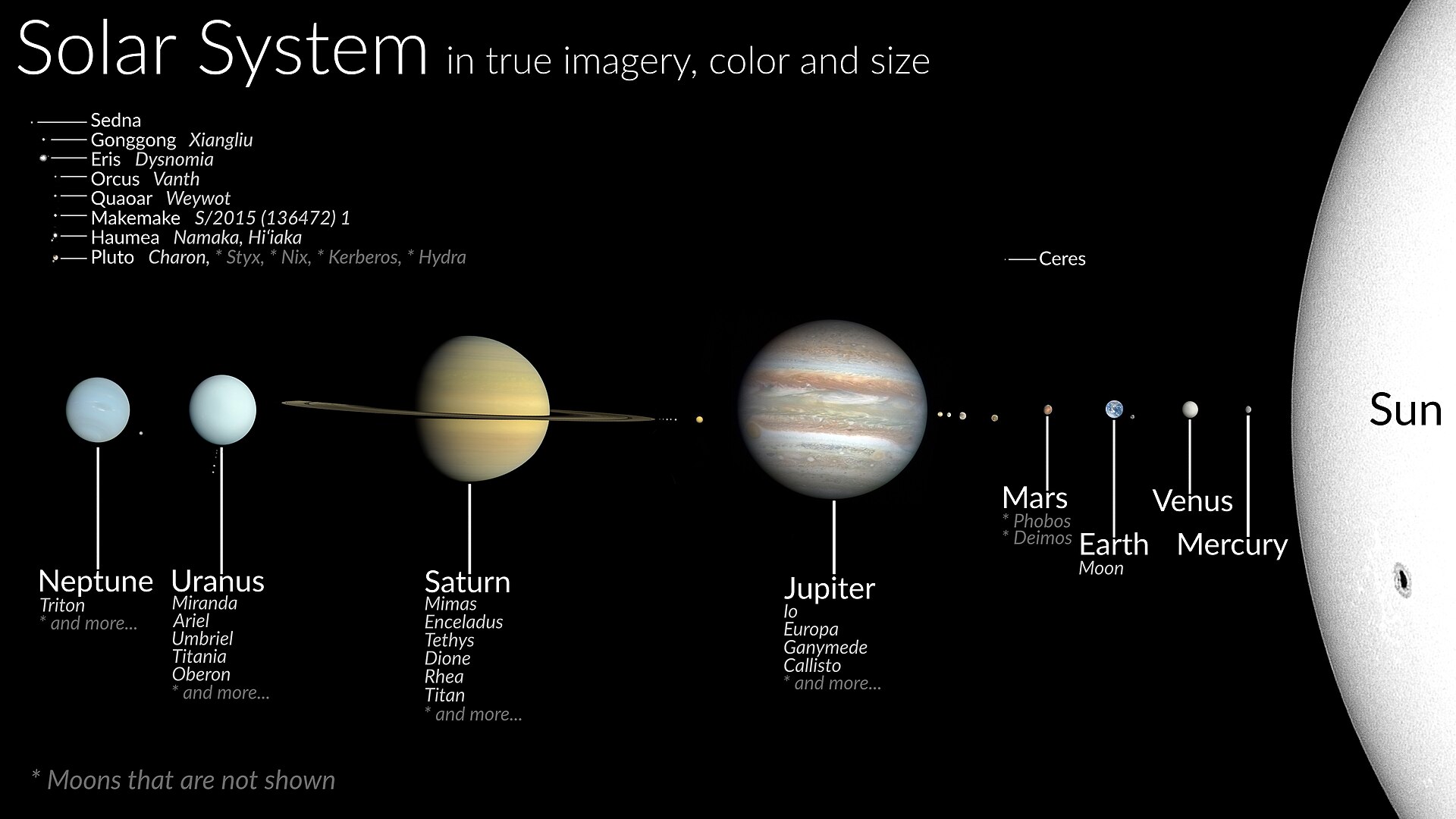
The Solar System is the Sun and everything bound to it by gravity: eight planets, several dwarf planets, scores of moons, and countless smaller bodies of rock and ice. It is our cosmic neighbourhood, a flattened disk of worlds orbiting a single ordinary star on one arm of the Milky Way galaxy.
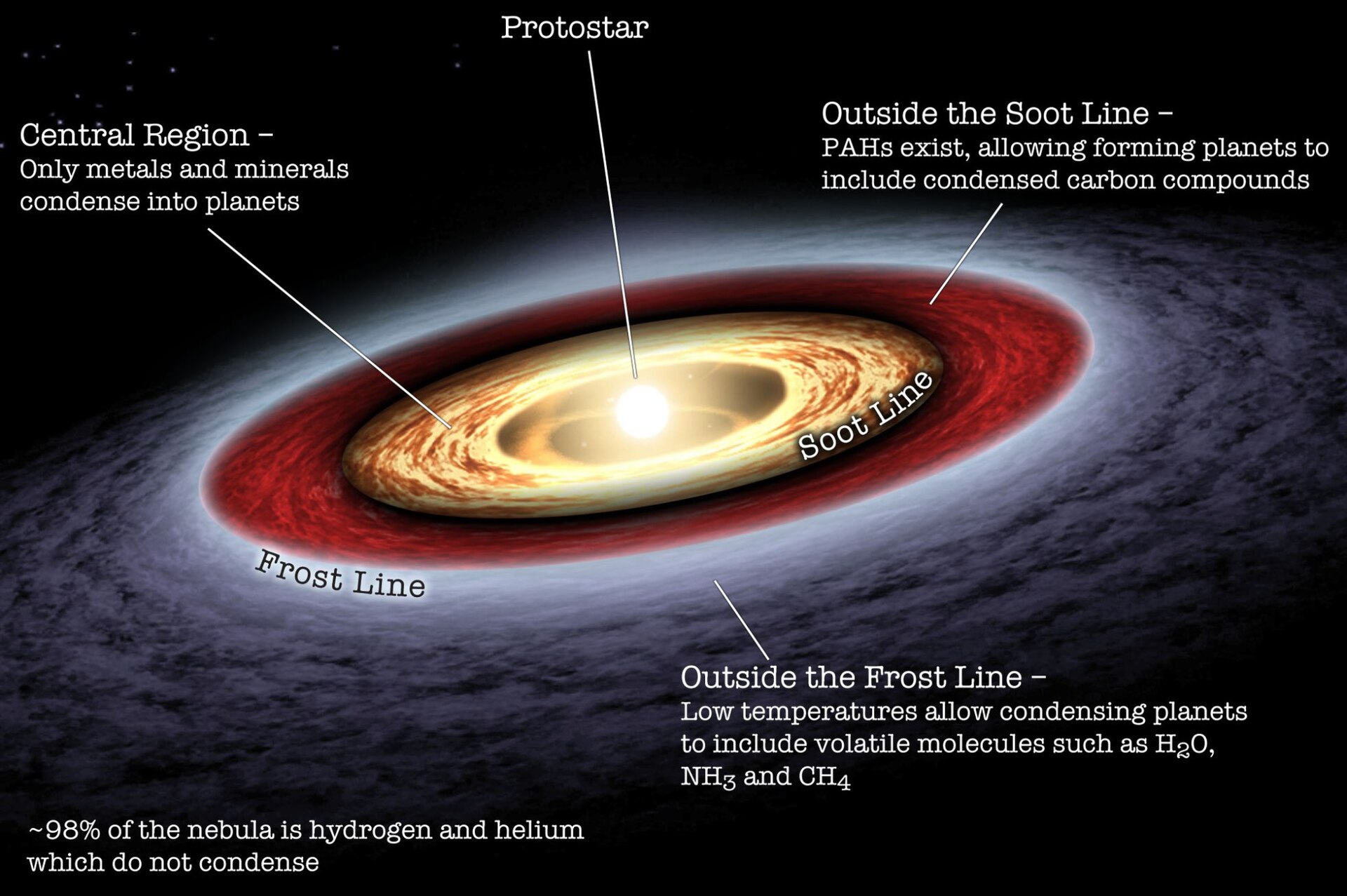
The Solar System formed about 4.6 billion years ago from a giant molecular cloud that collapsed under its own gravity. As the cloud contracted it spun faster and flattened into a rotating disk, with most of the material falling to the centre to ignite as the Sun. In the surrounding disk, dust grains stuck together into ever-larger bodies until they grew into planets, which is why all the planets orbit in nearly the same plane and the same direction.
The four inner planets, Mercury, Venus, Earth, and Mars, are small, dense, rocky worlds. Earth occupies a narrow band where liquid water can exist on the surface, the only world known to harbour life, while its neighbours are a scorched, cloud-wrapped Venus and a cold, rusty Mars that may once have been far more hospitable.
Beyond the asteroid belt lie the four giant planets: Jupiter and Saturn, immense balls of hydrogen and helium, and the ice giants Uranus and Neptune. Jupiter alone is more massive than all the other planets combined, and its powerful gravity has shaped the architecture of the whole system, herding asteroids and flinging comets across the Solar System.
Between Mars and Jupiter lies the asteroid belt, a region of rocky debris that never coalesced into a planet. Beyond Neptune is the Kuiper Belt, a broad ring of icy bodies that includes the dwarf planet Pluto, and far past that the hypothesised Oort Cloud, a distant shell of comets reaching perhaps a quarter of the way to the nearest star.
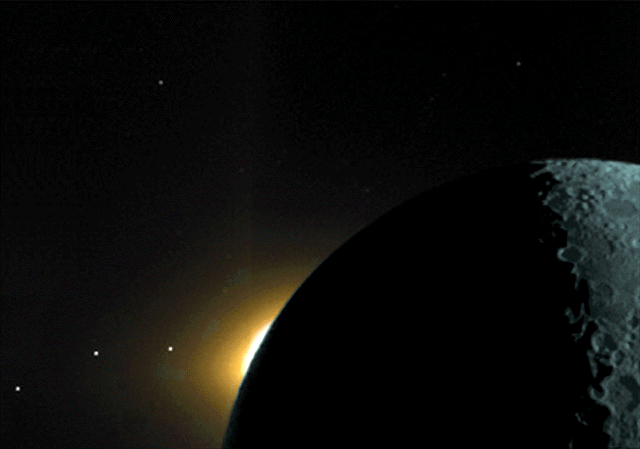
On rare occasions the scattered members of the Solar System can be glimpsed in a single view. From the vantage of the Moon or a spacecraft, planets and the Sun's faint corona can appear side by side, a reminder that these distant worlds all share one small region of the galaxy.
The Solar System is overwhelmingly empty space. Light from the Sun reaches Earth in eight minutes but takes more than five hours to reach Neptune. If the Sun were shrunk to the size of a grapefruit, Earth would be a grain of sand about fifteen metres away, and the system's edge would lie kilometres distant.
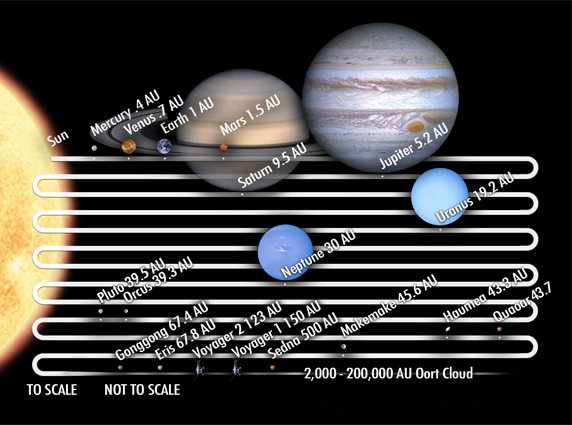
Understanding that scale is part of grasping our place in the cosmos: a handful of worlds clustered around one star, among hundreds of billions of stars in a single galaxy, itself one of countless galaxies. The Solar System is at once our entire neighbourhood and a vanishingly small speck in the wider universe.
