The Riemann hypothesis is the most famous unsolved problem in mathematics. Proposed by Bernhard Riemann in 1859, it makes a precise claim about the deep pattern hidden inside the prime numbers, and despite more than a century and a half of effort, no one has been able to prove or disprove it.
The prime numbers, those divisible only by themselves and one, are the building blocks from which all other whole numbers are made. Yet they seem to scatter through the number line without any obvious order, growing rarer as numbers get larger but never settling into a simple pattern. Understanding how they are distributed is one of the oldest goals in mathematics.
Riemann discovered that the distribution of the primes is governed by a function from advanced mathematics called the zeta function, and specifically by the locations where that function equals zero. The seemingly random scatter of the primes, he showed, is secretly controlled by these special points.
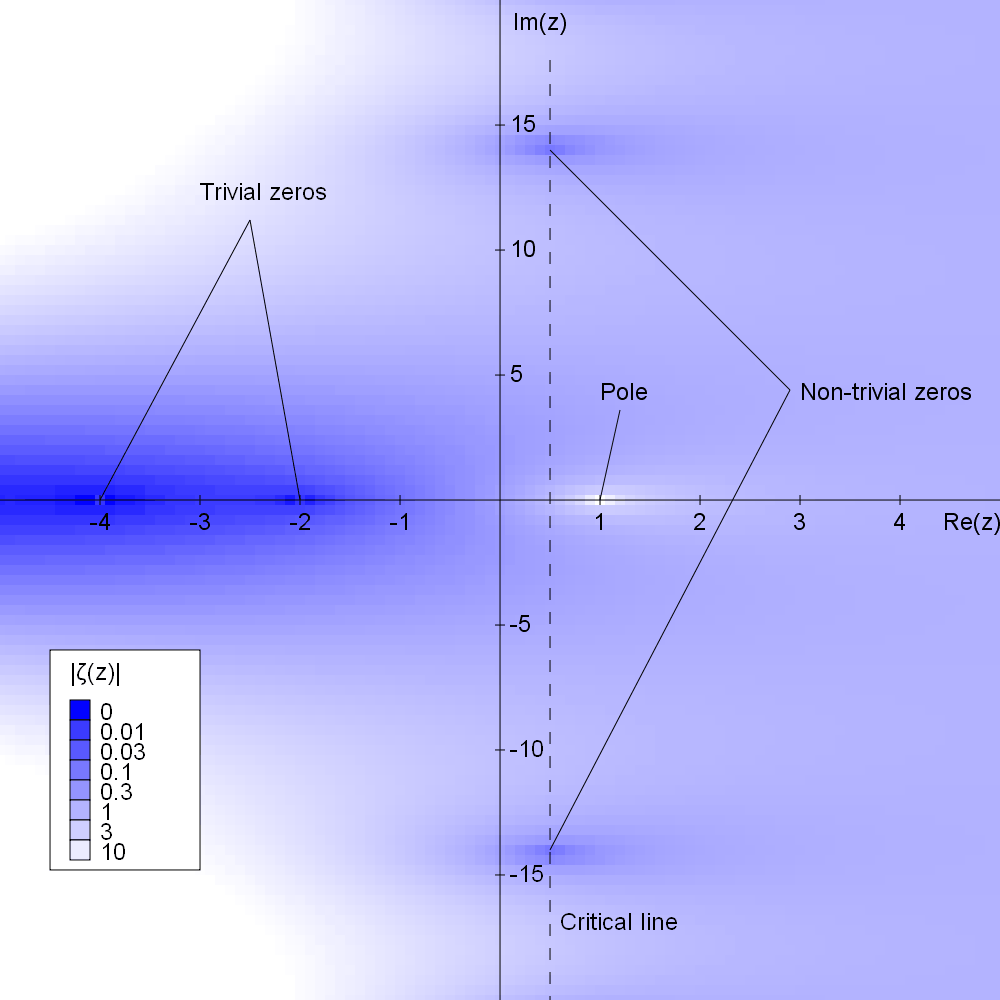
The hypothesis states that all the interesting zeros of the zeta function lie exactly on a single vertical line, called the critical line. If true, it would mean the primes are distributed as regularly as they possibly could be, with no unexpected clumping or thinning anywhere along the number line.
Computers have checked the first many trillions of these zeros, and every single one falls precisely on the critical line as predicted. This is powerful evidence, and almost every mathematician believes the hypothesis is true. But in mathematics, checking cases, however many, is not a proof, because there are infinitely many zeros and no computer can ever reach them all.
A proof would not be a mere curiosity. The hypothesis is woven into hundreds of other mathematical results that begin with the words "assuming the Riemann hypothesis," and confirming it would settle all of them at once. Its truth or falsehood ripples through number theory and beyond.
The Riemann hypothesis is one of the seven Millennium Prize Problems named in 2000, each carrying a reward of one million dollars for a solution. More than the money, a proof would bring lasting fame, for it would crack open one of the deepest mysteries in all of mathematics.
For now, the hypothesis remains exactly what it has been for generations: a statement believed by most mathematicians, supported by mountains of evidence, and proven by none. It stands as a reminder that some of the simplest questions about numbers are also among the hardest.
