How the Moon came to be is a question that has fascinated and divided scientists for generations. While one explanation is now favoured, important details remain genuinely contested, and no theory accounts for every observation perfectly.
The Moon is Earth's only natural satellite, a world about a quarter of Earth's diameter, unusually large compared with the moons of other planets. It governs the tides, steadies Earth's tilt and so its climate, and has shaped life and culture since the dawn of history.
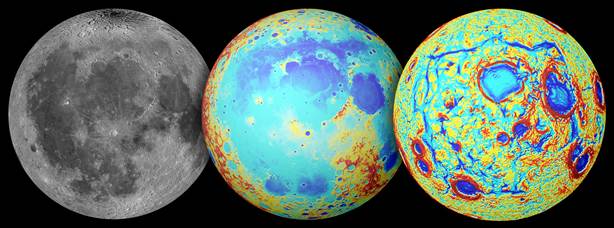
Any successful theory of the Moon's origin must explain several stubborn facts: its large size relative to Earth, the angle and speed of its orbit, its surprisingly small iron core, and above all the chemistry of its rocks, brought back by astronauts, which is strikingly similar to Earth's in some ways and different in others.
For a long time three older ideas competed. One said the Moon formed elsewhere and was captured by Earth's gravity. Another said it spun off a fast rotating young Earth. A third said the two formed side by side from the same cloud of material. Each struggled to fit the evidence, and all are now largely set aside.
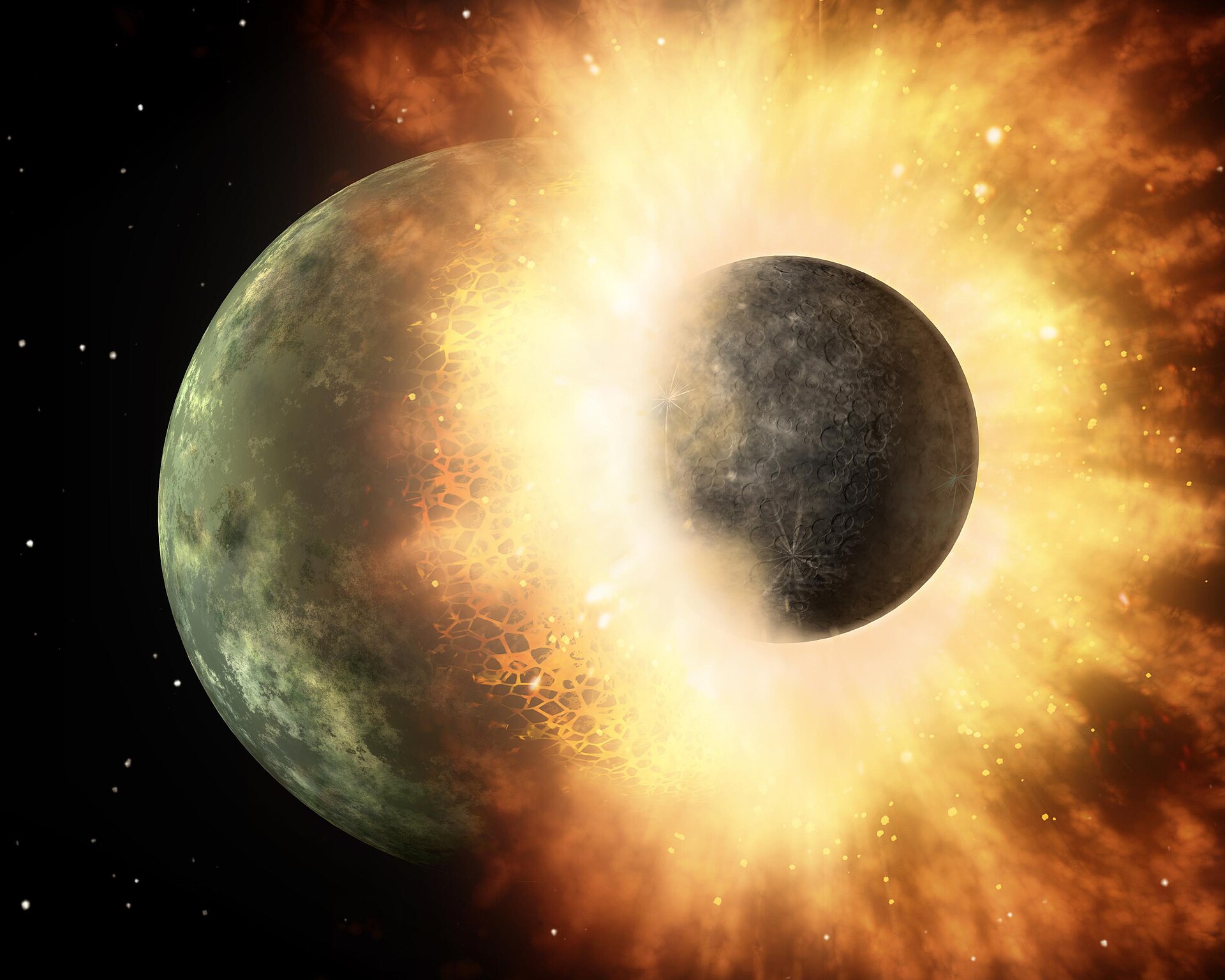
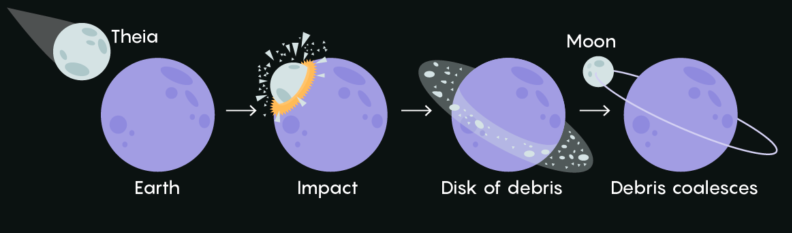
The favoured explanation is the giant impact hypothesis: that about four and a half billion years ago, a Mars sized body, sometimes called Theia, collided with the young Earth. The titanic crash blasted a huge amount of debris into orbit, which then gathered together to form the Moon.
The giant impact hypothesis neatly explains the Moon's size, its small iron core, and why its composition resembles Earth's outer layers rather than its iron rich centre. Computer simulations show such a collision could indeed throw off enough material to build a moon, and the broad picture fits much of the evidence.
Yet a deep puzzle remains. The Moon's rocks are almost identical to Earth's in certain chemical "fingerprints," the precise mix of isotopes. This is hard to explain if much of the Moon came from the impacting body, which should have had its own distinct composition. Solving this is the central challenge for the theory.
To resolve the puzzle, scientists debate variations of the giant impact. Perhaps the collision was so violent that it thoroughly mixed the two worlds into a single cloud before the Moon condensed. Perhaps there were several smaller impacts rather than one. Each version tries to match both the Moon's size and its earthlike chemistry.
The giant impact hypothesis is widely accepted in outline, but exactly how the collision played out, and how the isotope problem is solved, remain genuinely contested. New simulations, fresh analysis of lunar samples, and future missions may yet settle the details of how our nearest neighbour was born.
