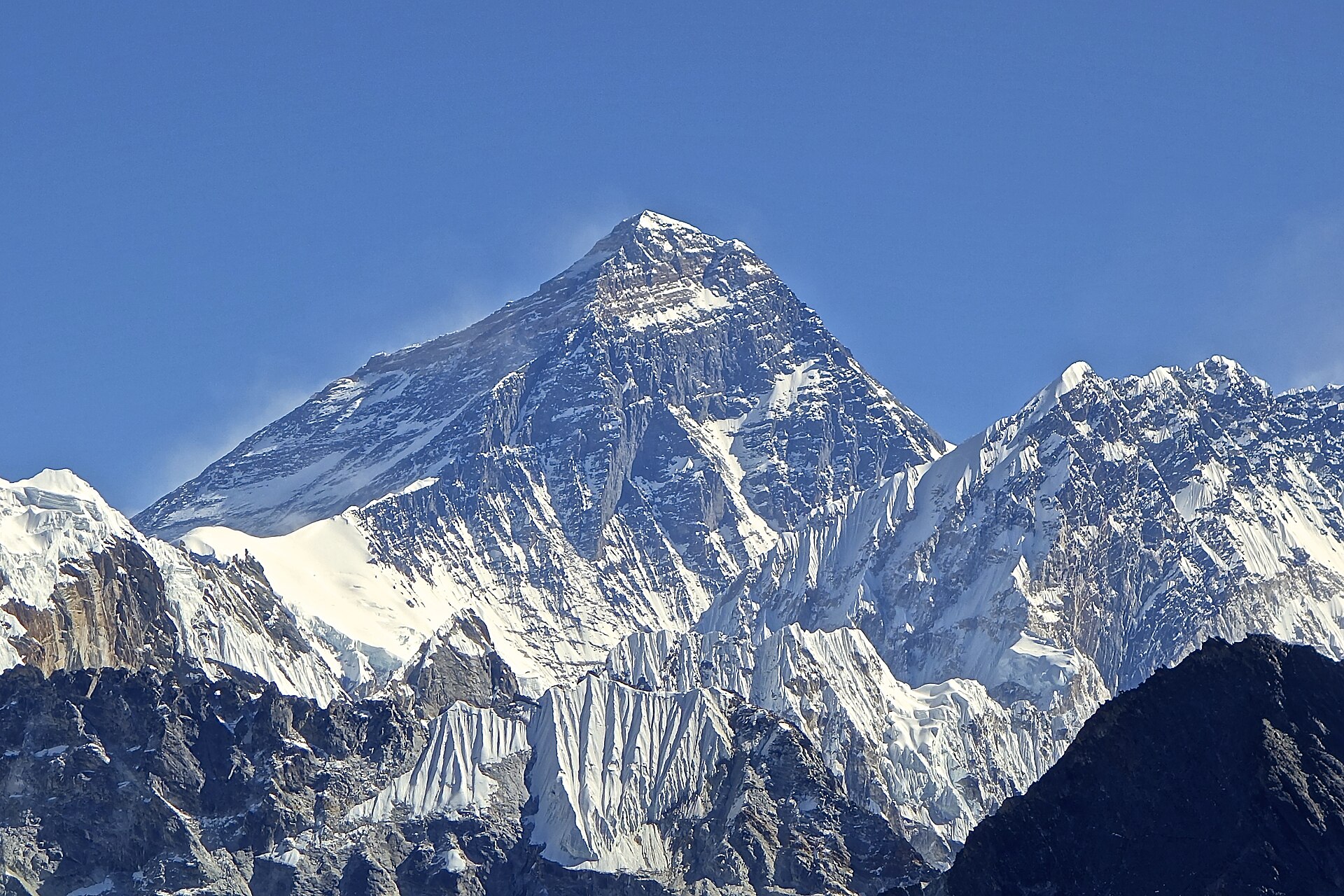
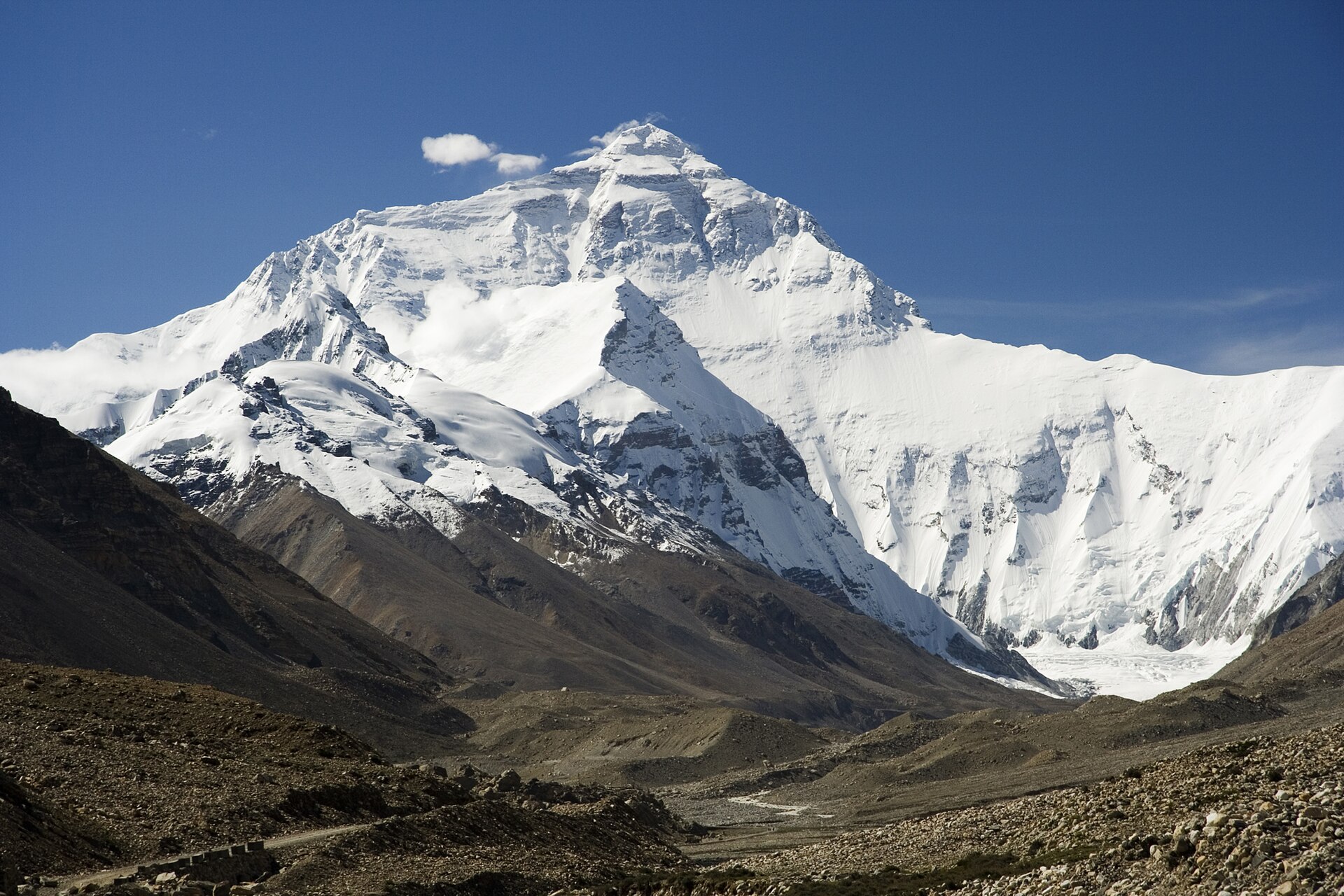
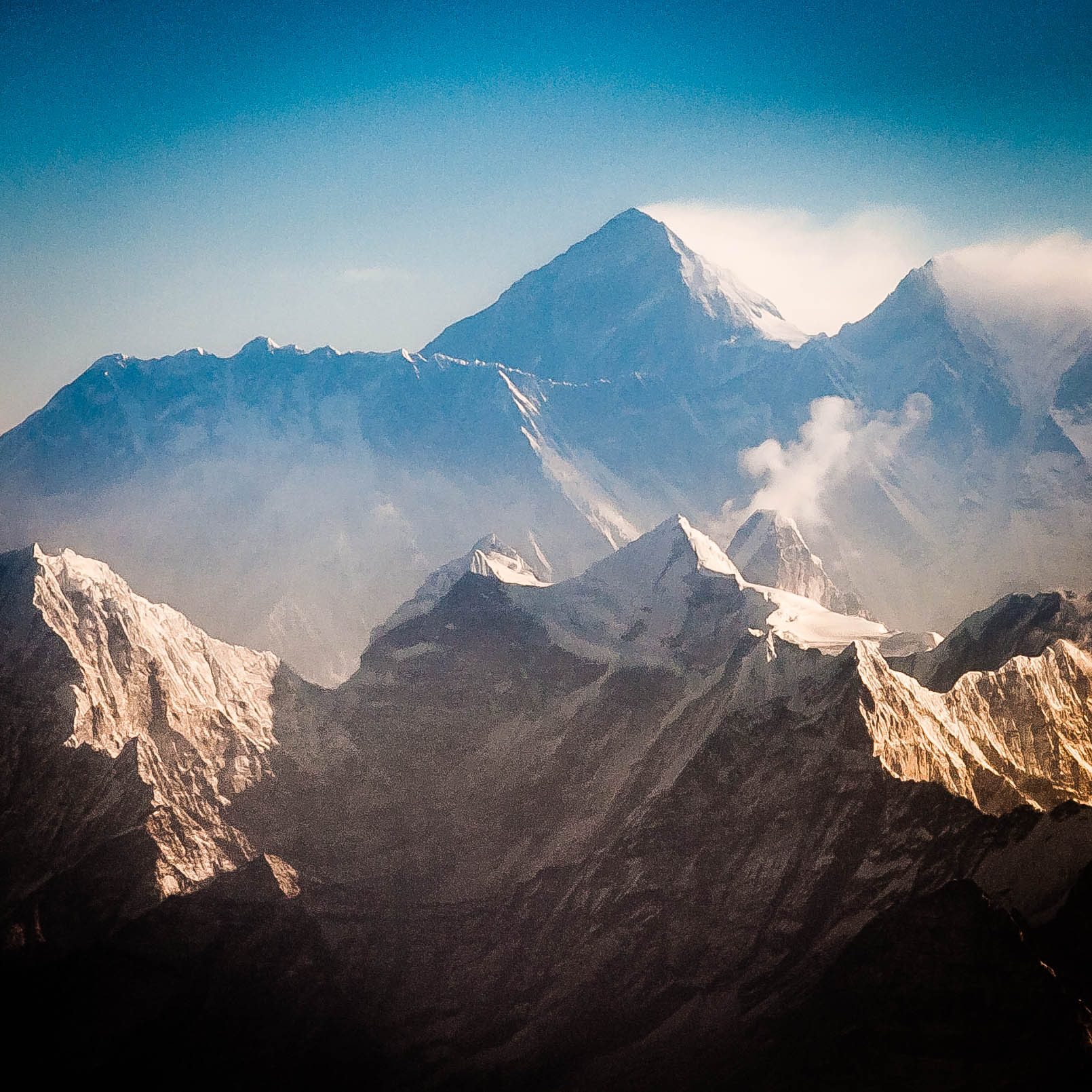
Mount Everest is the highest mountain on Earth as measured from sea level, with a summit reaching 8,848.86 metres (29,031.7 feet) above sea level, a figure agreed in 2020 by a joint survey conducted by Nepal and China. It stands on the border between Nepal and the Tibet Autonomous Region of China, in the Mahalangur Himal section of the Himalayas, and has become both a benchmark of the planet's vertical extremes and one of the most coveted, and dangerous, objectives in mountaineering.
Everest is a roughly pyramidal mass with three great faces, the North Face above Tibet, the Southwest Face above Nepal, and the rarely climbed East (Kangshung) Face, separated by long ridgelines including the Southeast, Northeast, and West ridges. It is ringed by other giants of the Himalaya, among them Lhotse (the fourth-highest mountain in the world), Nuptse, and Changtse, and is drained by major glaciers such as the Khumbu Glacier to the south and the Rongbuk Glacier to the north.
The mountain is still rising. The Indian tectonic plate continues to push beneath the Eurasian plate, lifting the entire Himalayan range by several millimetres a year, even as erosion and the occasional earthquake reshape its surface. The rock at the very summit is marine limestone, laid down on an ancient seafloor and carried skyward over tens of millions of years.
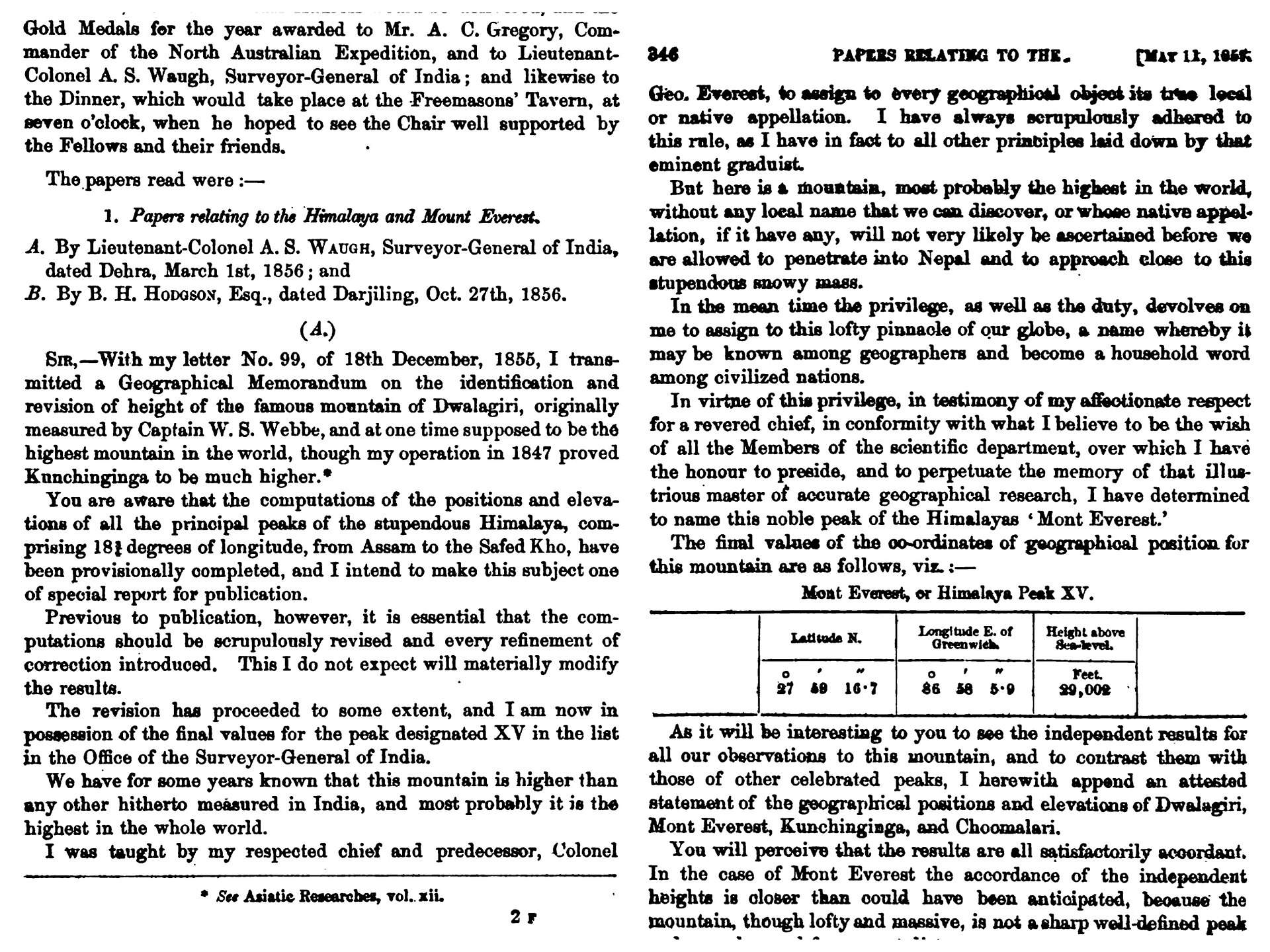
The mountain carries deep local names long predating its European designation: Sagarmāthā ("forehead in the sky") in Nepali and Chomolungma ("Goddess Mother of the World") in Tibetan. Its modern English name comes from the Great Trigonometrical Survey of India. In 1852 the Bengali mathematician and surveyor Radhanath Sikdar, working from theodolite readings taken at a distance, calculated that "Peak XV" was the highest known mountain on Earth. In 1865 the Royal Geographical Society named it after Sir George Everest, a former Surveyor General, over Everest's own objection that the peak already had local names.
Above about 8,000 metres lies what climbers call the "death zone." Air pressure there is roughly a third of that at sea level, so each breath delivers a fraction of the usual oxygen; the body slowly deteriorates, unable to acclimatise, and judgement, digestion, and healing all fail. Most climbers use bottled oxygen to survive it. Hurricane-force winds driven by the jet stream scour the summit for much of the year, and temperatures can fall below minus 40 degrees Celsius. The narrow windows of calmer weather, chiefly a few weeks in May before the summer monsoon, concentrate almost all summit attempts into short, crowded periods.
British expeditions reconnoitred the mountain in the 1920s. On the 1924 attempt, George Mallory and Andrew Irvine disappeared high on the Northeast Ridge; whether they reached the top before they died remains one of mountaineering's enduring mysteries. The first confirmed ascent came on 29 May 1953, when Tenzing Norgay and Edmund Hillary reached the summit by the Southeast Ridge as part of a British expedition. In 1978 Reinhold Messner and Peter Habeler made the first ascent without supplemental oxygen, long thought physiologically impossible, and in 1980 Messner climbed it solo, again without bottled oxygen.
Two routes account for the overwhelming majority of ascents: the South Col route from Nepal, which threads the shifting, hazardous Khumbu Icefall, and the Northeast Ridge route from Tibet. Both pass through a series of fixed camps and culminate in famous obstacles such as the Hillary Step.
Since the 1990s, commercial guiding has transformed the mountain. Hundreds of climbers may attempt the summit in a single good-weather day, producing dangerous bottlenecks on exposed ridges, a problem made vivid by the 1996 disaster and by later photographs of long queues near the top. The crowds have intensified debate over safety, the heavy reliance on Sherpa labour, accumulated waste and abandoned equipment, and the more than 300 people who have died on the mountain, many of whose bodies remain where they fell.
