Information theory is the mathematical study of how information is measured, stored, and communicated. It defines what information actually is in precise quantitative terms and sets the ultimate limits on how much can be compressed and how reliably it can be sent through a noisy channel. It is the theoretical bedrock of the entire digital age.
The field was created almost single-handedly by Claude Shannon in his 1948 paper "A Mathematical Theory of Communication". In one stroke he introduced the bit as the fundamental unit of information and gave communication a rigorous mathematical foundation where before there had been only engineering intuition.
Shannon defined entropy as a measure of uncertainty, or how surprising a message is on average. The more predictable a source, the less information each symbol carries. A coin that always lands heads tells you nothing new, while a fair coin carries exactly one bit per toss. This simple idea turned the vague notion of information into something that could be measured and calculated.
From entropy, Shannon derived hard limits. He showed exactly how far a message can be compressed without losing anything, the principle behind every zip file and streaming video. He then proved that every communication channel has a fixed capacity, a maximum rate at which information can be sent through it with arbitrarily small error, no matter how much noise is present.
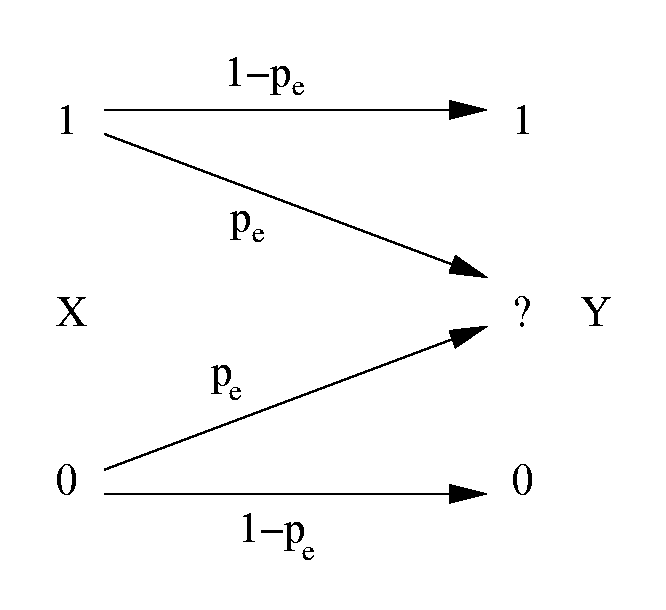
Perhaps his most startling result was that reliable communication is possible even over a noisy channel. By cleverly adding structured redundancy, error correcting codes let data survive corruption and arrive perfectly intact, as long as the rate stays below the channel's capacity.

Shannon's results are not abstractions; they are designed into everything. Data compression formats, the error correcting codes that let scratched discs and distant spacecraft transmit cleanly, the capacity of mobile networks, and modern cryptography all rest directly on his theorems.
