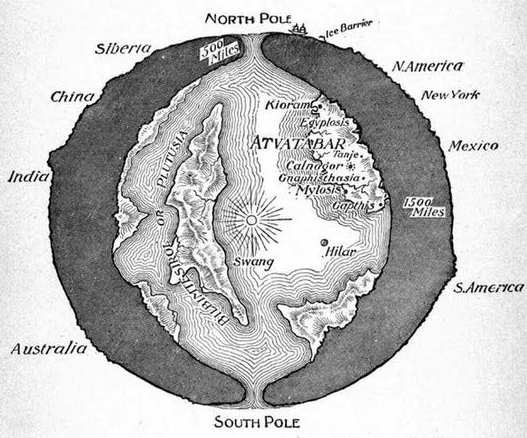
The hollow Earth was the idea that our planet is not solid but hollow, perhaps containing a habitable inner world, or even inner suns and civilizations. Once entertained by a few serious thinkers and later a favourite of fiction, it has been completely debunked by modern science.
Over the centuries, various people proposed that the Earth might be hollow, with vast spaces inside, sometimes reached through openings at the poles. The notion captured the imagination, suggesting hidden realms, strange creatures, and lost civilizations lying somewhere beneath our feet, waiting to be discovered.

The idea was not always pure fantasy. In the seventeenth century even the respected astronomer Edmond Halley, of comet fame, suggested the Earth might contain concentric shells separated by spaces, partly to explain puzzling variations in the planet's magnetism. It was a reasonable guess, given how little was then known about the deep Earth.
As science moved on, the hollow Earth lived on in fiction. Novels imagined explorers descending into underground worlds full of prehistoric beasts and strange peoples. These stories were thrilling, and they kept the idea alive in popular imagination long after scientists had abandoned it.
Modern science shows beyond doubt that the Earth is solid, apart from its molten outer core. The strongest evidence comes from seismology. Earthquakes send waves through the planet, and by tracking how these waves speed up, slow down, and bend as they pass through different layers, scientists have mapped the interior in detail.
The picture that emerges is clear and consistent: a thin rocky crust, a thick mantle of hot rock, a liquid outer core of molten metal, and a solid inner core. There is no hollow space, no inner world. The interior is dense rock and metal all the way down.
The Earth's measured mass and the strength of its gravity also rule out a hollow interior. A hollow planet would weigh far too little to match what we observe, and would not hold together or pull on us as the Earth does. The numbers simply do not allow it.
Every line of evidence points the same way. Seismic waves, gravity measurements, the behaviour of the magnetic field, and the dense volcanic rock brought up from the depths all describe a solid Earth. No observation supports a hollow one, and many flatly contradict it.
The hollow Earth survives only as a piece of folklore and science fiction, firmly debunked as a description of reality. It remains a charming idea and a staple of adventure stories, but the real Earth beneath us is a solid, layered ball of rock and metal, every bit as wondrous as any imagined inner world.
