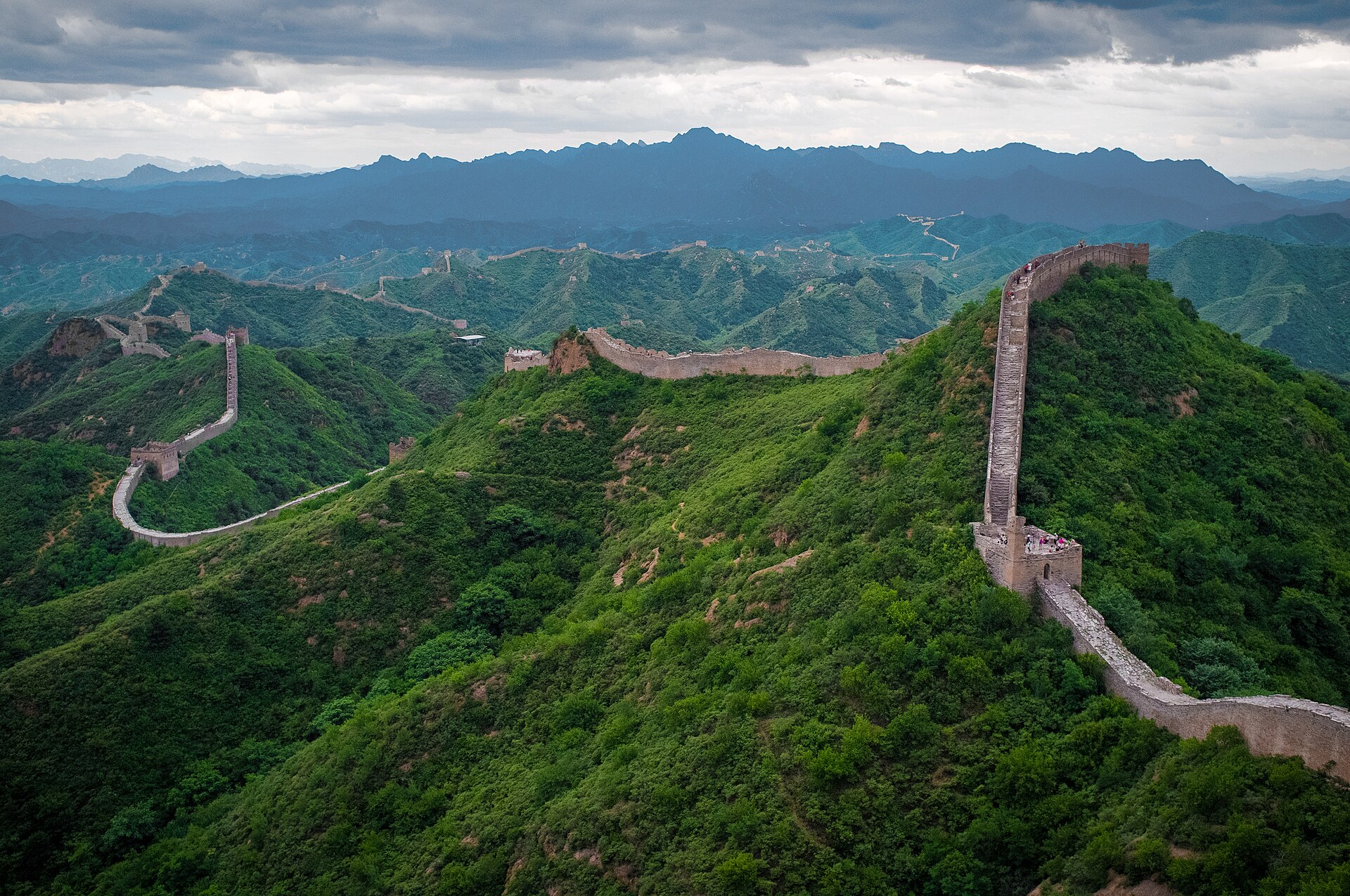
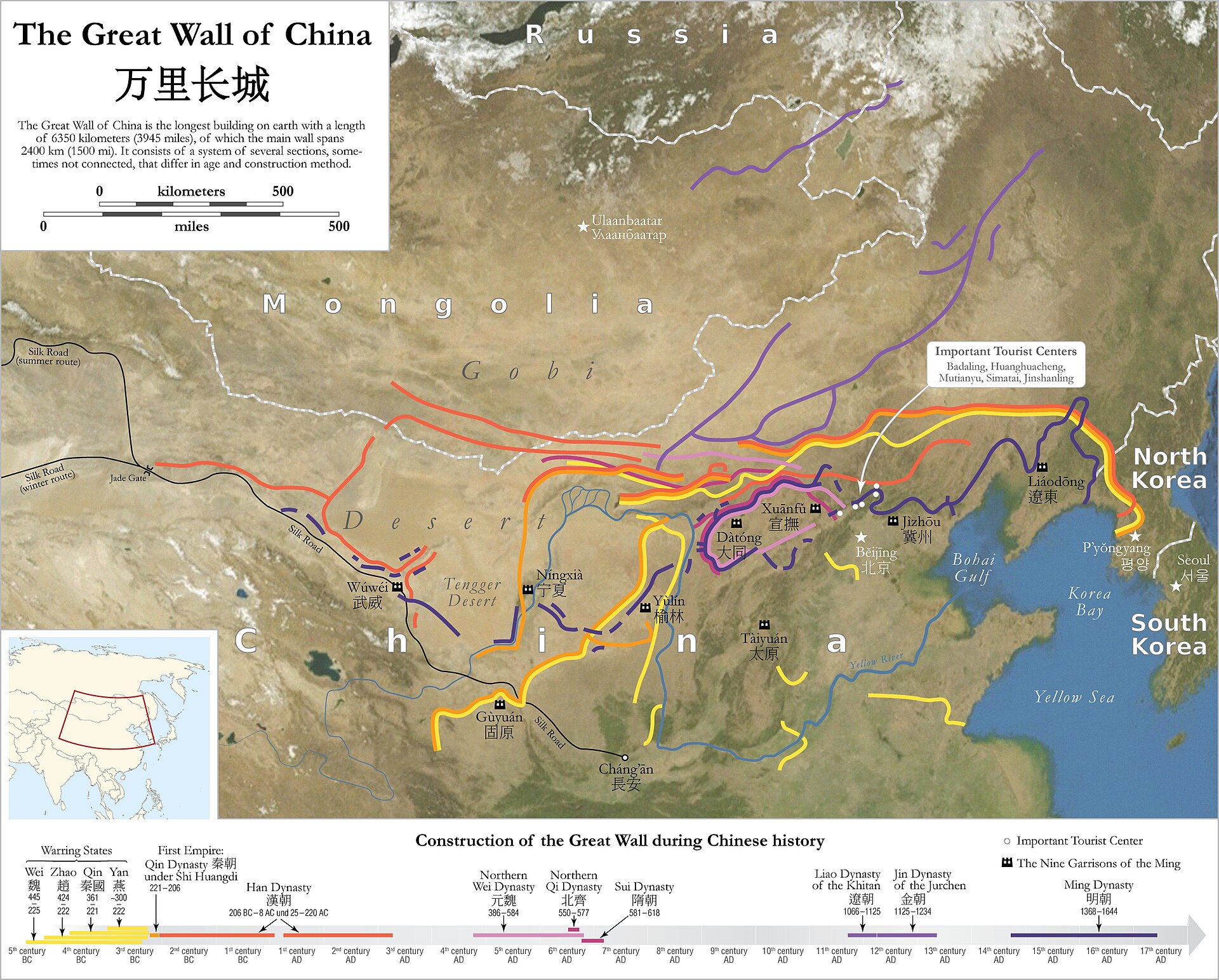
The Great Wall of China is not a single wall but a vast, discontinuous system of fortifications, walls, watchtowers, garrisons, and beacon towers, built and rebuilt across the northern frontier of China over more than two thousand years. A comprehensive archaeological survey completed in 2012 measured the combined length of all its sections, across every dynasty, at about 21,196 kilometres (13,171 miles), making it the largest construction project in human history.
Rather than one continuous barrier, the Wall is a layered patchwork of frontier defences raised by successive states and dynasties, often along different lines. Its purpose was never purely to stop armies. The walls regulated the movement of people and goods across the frontier, protected trade along the Silk Road, levied duties, controlled emigration, and provided an elevated network for transport and rapid communication. Garrisons signalled the approach of raiders by smoke during the day and fire at night, relaying warnings along the line far faster than a rider could travel.
The adversaries the walls faced were the mobile pastoral peoples of the northern steppe, the Xiongnu in antiquity, and later confederations culminating in the Mongols, whose cavalry could strike deep into settled China and withdraw before a response could be mounted.
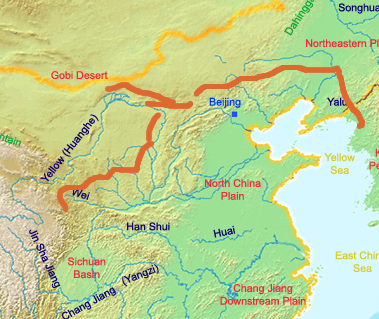
Long before unification, rival states of the Warring States period built defensive walls along their own borders. After Qin Shi Huang unified China in 221 BC, he ordered these earlier walls connected and extended into a single northern line, while destroying the internal walls that had divided the former states. The work, carried out largely in rammed earth by conscripted soldiers, peasants, and convicts, was enormous and brutally costly in human life, and it fixed the Wall in Chinese memory as both a symbol of imperial power and of the suffering ordinary people bore to build it.
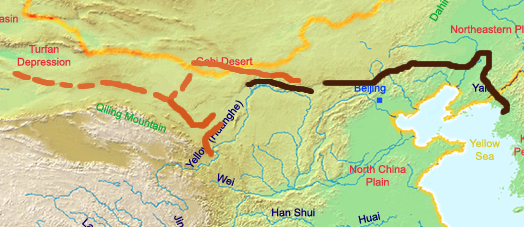
Under the Han dynasty the Wall reached its greatest historical extent, pushed far to the west to guard the Hexi Corridor and the Silk Road trade through the deserts of Central Asia. The Han walls are the longest ever built. In the centuries that followed, the frontier defences were variously abandoned, repaired, and rebuilt by dynasties such as the Northern Wei, Northern Qi, and Sui, according to the threats and resources of each era.
The Wall most people picture today is overwhelmingly the work of the Ming dynasty (1368 to 1644). After expelling the Mongol Yuan dynasty, the Ming rebuilt the northern defences on a grand scale, this time faced in brick and dressed stone rather than rammed earth. The famous, well-preserved sections, Badaling, Mutianyu, Jinshanling, the western terminus at Jiayuguan, and the eastern terminus where the Wall meets the sea at Shanhaiguan, date from this period. Ironically, the Ming Wall did not save the dynasty: in 1644 a Ming general opened the gates at Shanhaiguan to the Manchus, who went on to found the Qing dynasty.
The Wall's builders adapted their materials to the land. In the western deserts they tamped earth and gravel between wooden frames; in the rocky, populous east they used quarried stone and kiln-fired brick. Crenellated ramparts wide enough to march troops along were punctuated by watchtowers for storage and signalling and by larger fortresses housing permanent garrisons.
Much of the Wall has since crumbled, eroded by wind and rain, scavenged for building stone, and in places worn away by mass tourism. One persistent myth deserves correction: the Great Wall is not visible to the unaided eye from space. It is long but narrow, and roughly the colour of the ground it sits on, and astronauts have repeatedly confirmed that it cannot be picked out from low Earth orbit without aid.
