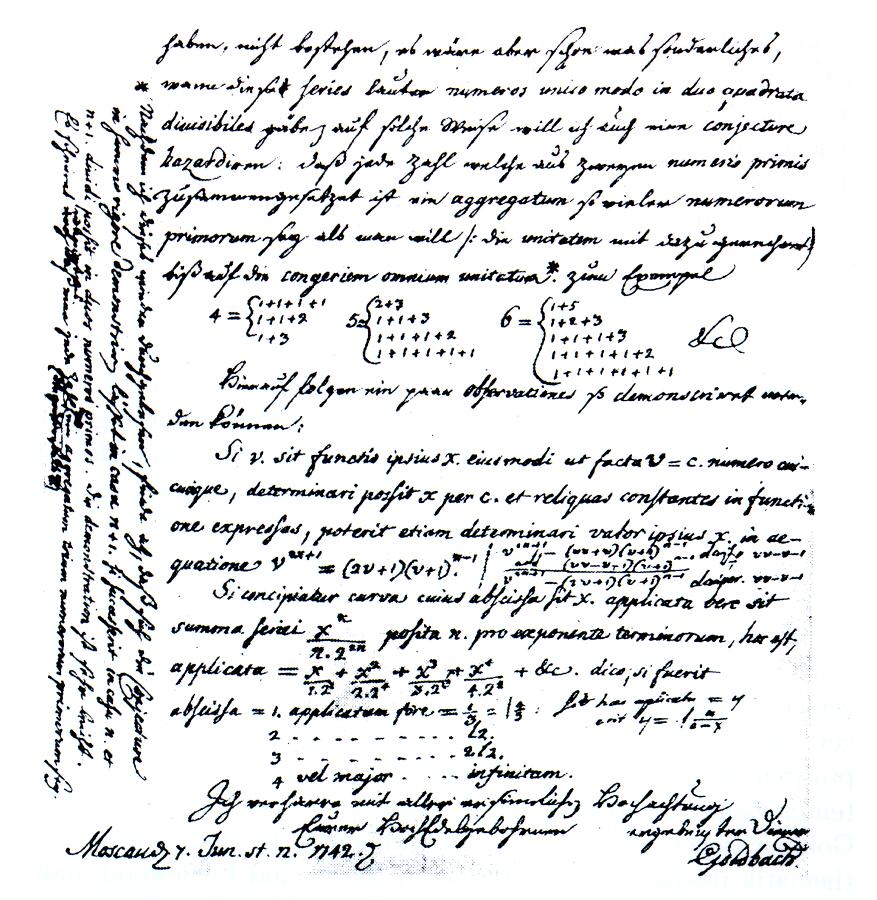
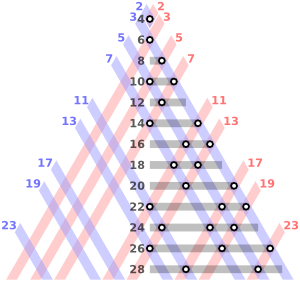
Goldbach's conjecture is one of the oldest and simplest sounding unsolved problems in mathematics. It states that every even whole number greater than two can be written as the sum of two prime numbers. For example, 8 is 3 plus 5, and 20 is 7 plus 13. Easy to state and easy to test, it has nonetheless never been proven.
The conjecture dates to 1742, when the Prussian mathematician Christian Goldbach raised the idea in a letter to the great Leonhard Euler. Euler, one of the most powerful mathematicians in history, found the claim entirely believable but admitted he could not prove it. Nearly three centuries later, his successors are in exactly the same position.
The conjecture is easy to explore by hand. Pick any even number and one can quickly find a pair of primes that add up to it, often in several different ways. The larger the number, in fact, the more such pairs tend to exist, which is part of why the conjecture seems so robust.
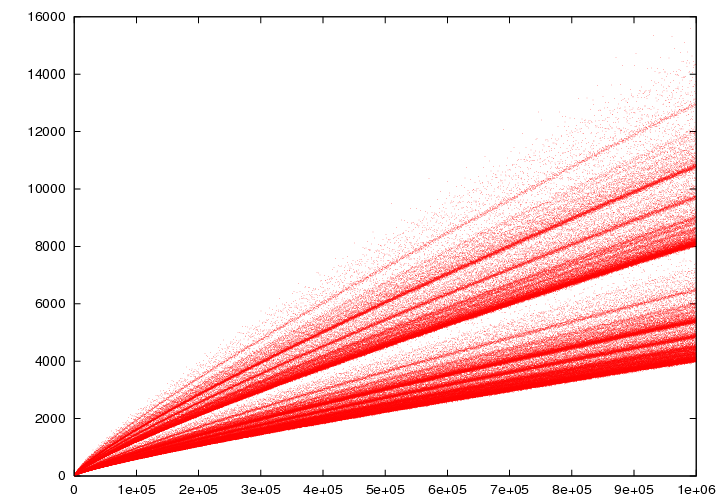
Computers have verified Goldbach's conjecture for every even number up to enormous values, far beyond any practical need, and it holds without a single exception. Plotting the number of ways each even number can be split into two primes produces a striking, ever widening pattern known as Goldbach's comet.
Mathematicians have proven closely related, slightly weaker statements. It has been shown, for instance, that every large enough odd number can be written as a sum of three primes, and that every even number is the sum of a prime and a number with at most two prime factors. These are real achievements, but none quite reaches the original claim.
Checking cases, no matter how many, is not the same as a proof, because there are infinitely many even numbers, and no calculation can ever reach them all. A true proof must cover every even number at once, with a single watertight argument, and that is what has eluded everyone.
Goldbach's conjecture is a striking example of a phenomenon common in mathematics: a statement that seems almost certainly true, that everyone believes, and that nonetheless resists every attempt at proof. The primes are simply too irregular for the existing tools to pin the claim down.
Until someone supplies a rigorous argument that covers all even numbers, Goldbach's conjecture remains a hypothesis, one of the most famous open problems about the prime numbers and a favorite challenge for amateur and professional mathematicians alike.
