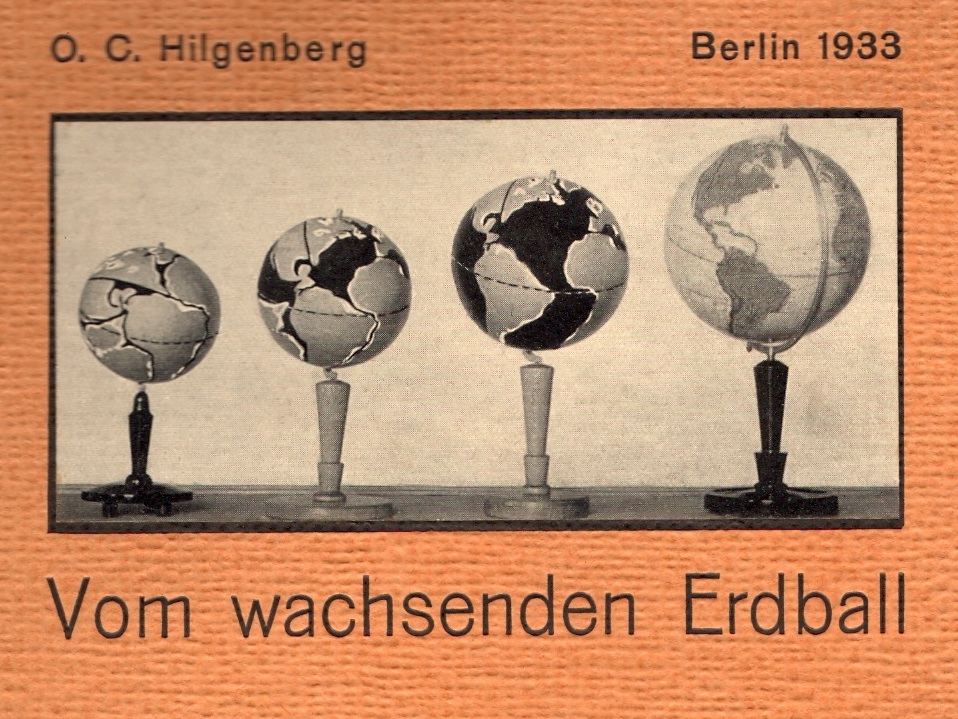
The expanding Earth was a hypothesis, taken seriously by some scientists into the twentieth century, which claimed that the planet is steadily growing larger, and that this growth pushed the continents apart. It has been thoroughly debunked by the theory of plate tectonics.
Geologists had long noticed that the continents seem to fit together, as if they were once joined. The coastlines of Africa and South America, in particular, look like pieces of a torn page that could be rejoined. This striking fit cried out for an explanation, and several were proposed.
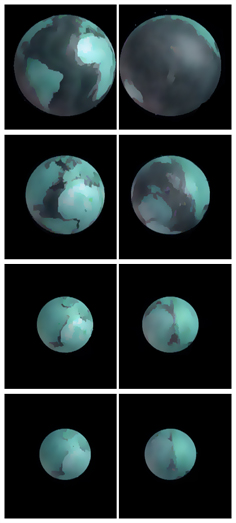
One explanation was the expanding Earth. On this view, the planet had once been much smaller, with the continents forming a single unbroken shell of rock covering its whole surface. As the Earth swelled, the shell cracked and the pieces, the continents, drifted apart on the growing sphere, opening the oceans between them.
The idea was not absurd given the knowledge of the time, and it was championed by some respected scientists, who built models and globes to illustrate how a smaller early Earth could have grown. It offered a tidy explanation for the matching coastlines and the spreading apart of the continents.
The expanding Earth faces a fatal problem: there is no known way for the planet to gain the enormous amount of mass or volume the idea requires. To swell as the theory demands, the Earth would have to create matter or energy from nowhere, violating fundamental laws of physics. No source for such growth exists.

Crucially, precise measurements show that the Earth is not growing at all. Using satellites and careful geodesy, scientists have confirmed that the planet's size is essentially constant. The very growth the theory depends on simply is not happening, which alone is enough to rule it out.
Meanwhile, the real explanation was found. The continents move because of plate tectonics, the slow shifting of rigid plates over the Earth's surface. New crust forms at undersea ridges where plates pull apart, while old crust sinks back into the interior elsewhere, so the planet stays the same size as it recycles its surface.
Plate tectonics, confirmed in the 1960s, explained the fit of the continents, the patterns of earthquakes and volcanoes, the spreading of the seafloor, and much more, all without any change in the planet's size. It accounted for the evidence far better than the expanding Earth ever could.
With no source for its growth, no evidence that the Earth is expanding, and a superior rival in plate tectonics, the expanding Earth was left with nothing in its favour. It is now firmly debunked, remembered mainly as a stepping stone on the road to understanding how our restless planet really works.
