Cosmic inflation is the hypothesis that, in the first tiny fraction of a second after the Big Bang, the universe expanded at an almost unimaginable rate, ballooning in size enormously before settling into the steadier expansion we see today. It is a leading but not fully confirmed idea in cosmology.
The idea is that in a sliver of a second after the universe began, far less than a billionth of a billionth of a second, space expanded exponentially, doubling in size again and again until a microscopic region had ballooned to a vast scale. Then this furious expansion ended, leaving the gentler expansion observed ever since.
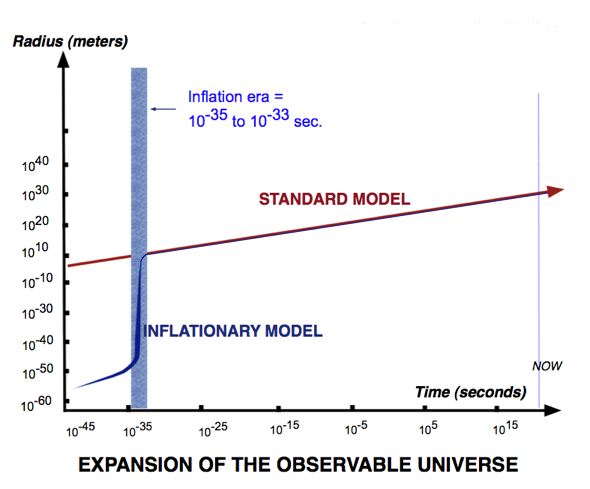
Inflation was proposed in the early 1980s, chiefly by the physicist Alan Guth, to solve puzzles the basic Big Bang could not. The universe looks remarkably uniform in every direction and is very nearly flat in its geometry, both surprising facts that the plain Big Bang left unexplained.
The universe is strikingly uniform: regions on opposite sides of the sky, too far apart to have ever exchanged light or heat, nonetheless look almost identical. Inflation explains this by proposing that these regions were once close together, in contact, before being flung far apart by the burst of expansion.
Measurements show that the overall geometry of the universe is extraordinarily flat, balanced on a knife edge. Inflation makes this natural: stretching any curved surface enormously makes it appear flat, just as the vast Earth seems flat underfoot. A brief, huge expansion would smooth out any initial curvature.
The theory holds that tiny quantum ripples present at that first instant were stretched to cosmic scale by inflation, seeding the slight variations in density that later grew, under gravity, into galaxies and clusters. This gives inflation real predictive power, linking the smallest quantum fluctuations to the largest structures in the cosmos.
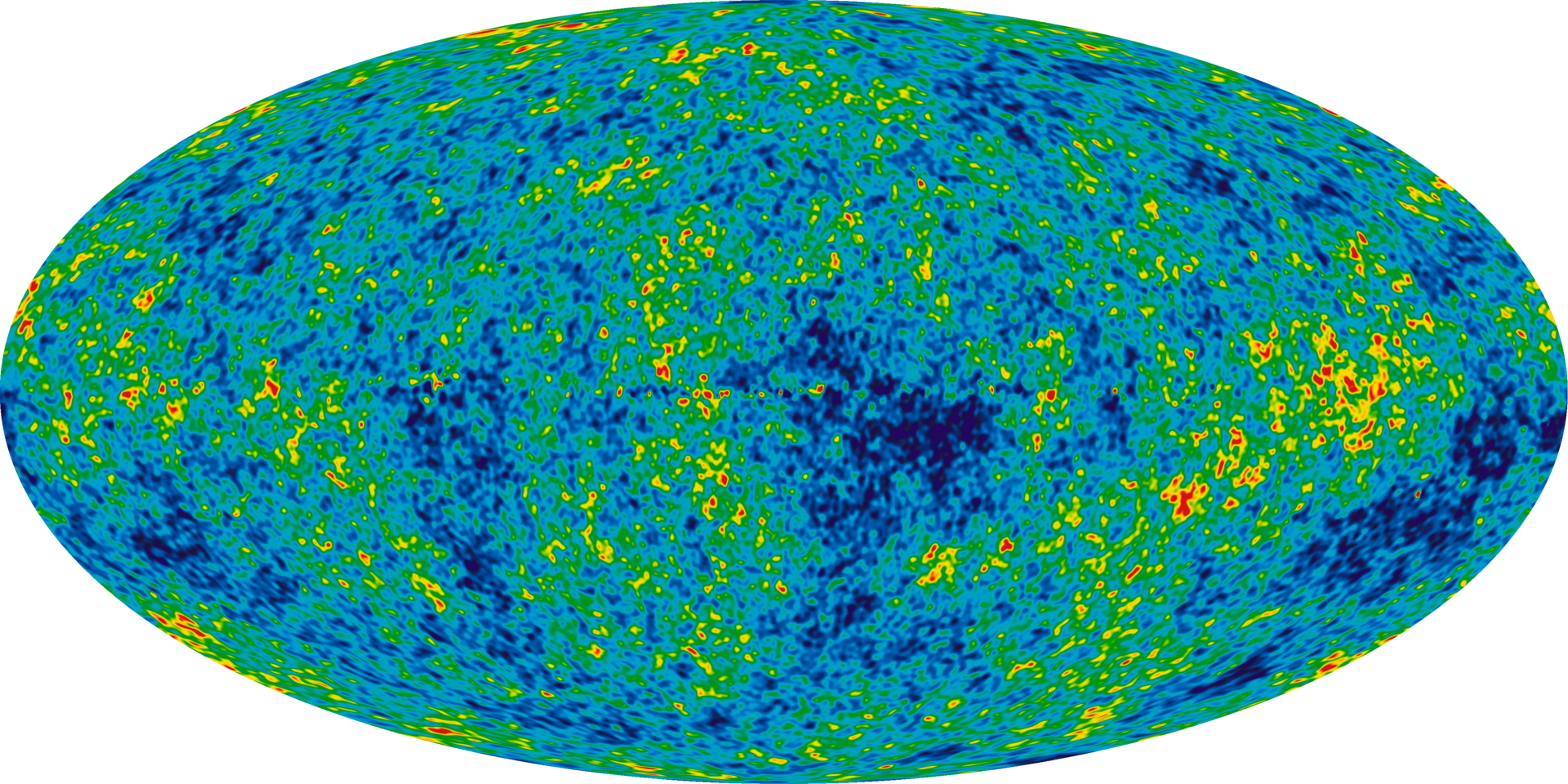
Inflation's predictions for the precise pattern of ripples in the cosmic microwave background, the faint afterglow of the early universe, match observations strikingly well. This agreement is the strongest evidence in inflation's favour, and it is why the idea has become the leading account of the universe's first moments.
Yet inflation is not settled. The exact mechanism, the strange energy that supposedly drove the expansion, is unknown, and there are many competing versions of the theory. Some predicted signals, such as particular gravitational waves from the inflationary era, have been searched for but not yet found.
Whether inflation truly happened, and if so exactly how, remains an open frontier. Some physicists question the idea altogether and seek alternatives. For now, cosmic inflation stands as a powerful and successful hypothesis about the birth of the universe, awaiting the decisive evidence that would confirm it or rule it out.
