Chaos theory is the branch of mathematics that studies systems whose behaviour is exquisitely sensitive to their starting conditions. Such systems are fully deterministic, governed by exact rules with no randomness, yet they are effectively impossible to predict over the long term, because the tiniest difference in where they begin grows into an enormous difference in where they end up.
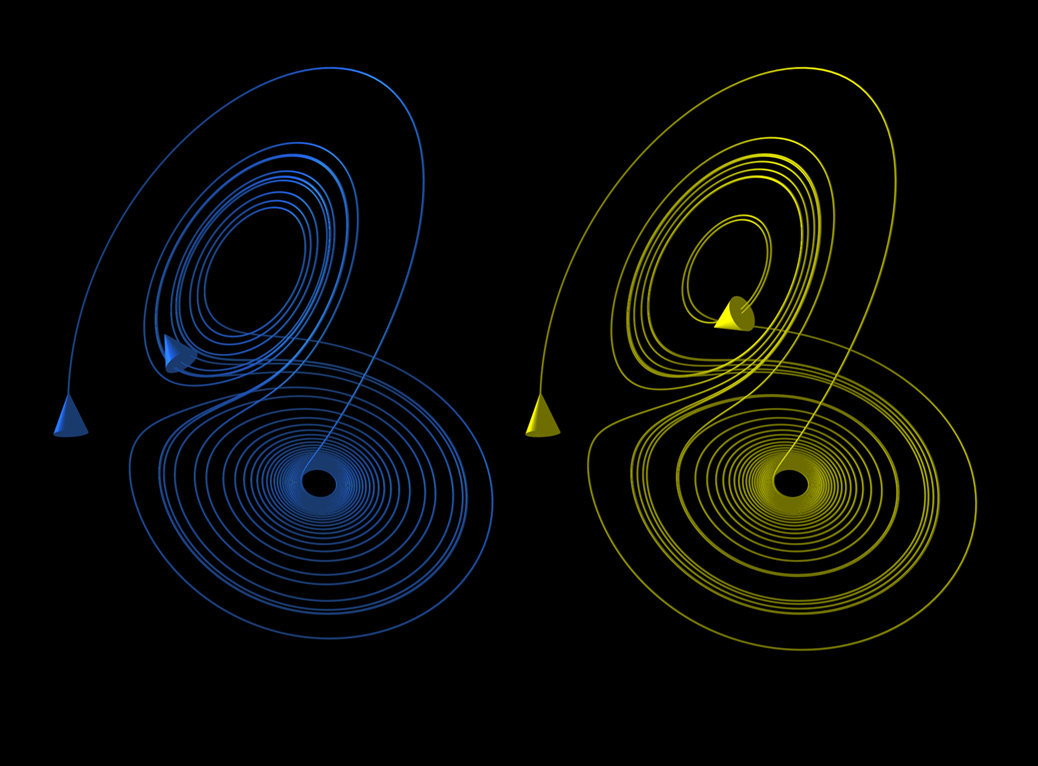
In 1961 the meteorologist Edward Lorenz, running a simple weather model, found that rounding a number from six decimal places to three produced a completely different forecast. That discovery of "sensitive dependence on initial conditions" became famous as the butterfly effect: the idea that a butterfly flapping its wings might, in principle, alter the path of a distant tornado.
The theory's surprising lesson is that determinism does not guarantee predictability. Because measurement is never perfectly precise, the unavoidable error in our knowledge of a chaotic system's present state balloons over time, setting a hard horizon beyond which prediction fails.
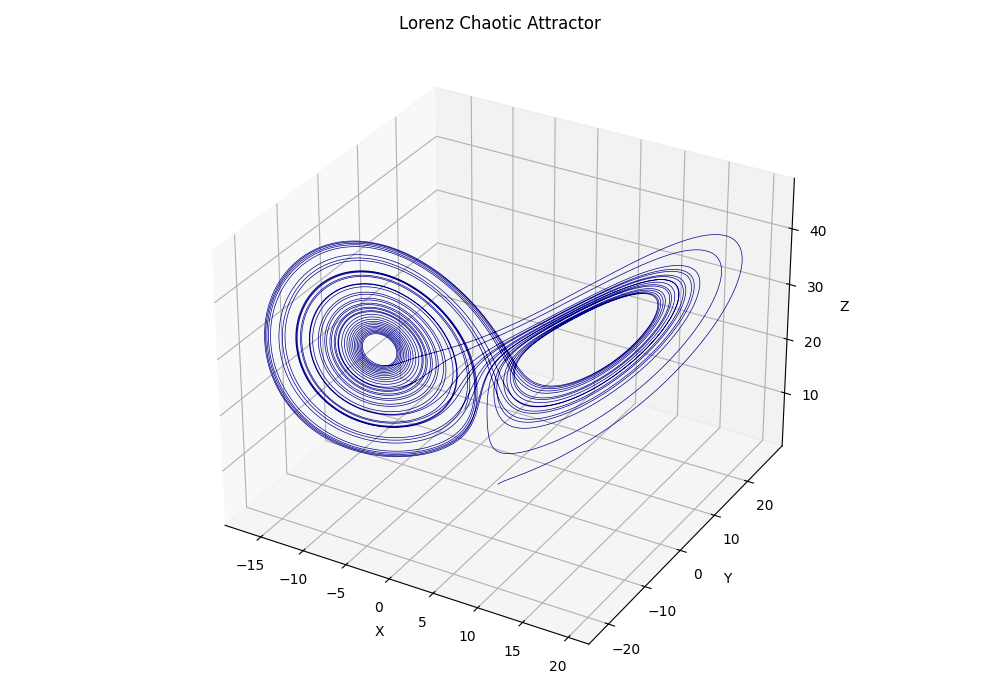
Chaos is not the same as randomness. Within the unpredictability there is hidden structure: chaotic systems often settle onto elegant geometric forms called strange attractors, which trace out the same intricate shape no matter where the system starts. The famous Lorenz attractor, resembling a butterfly's wings, is the classic example.
One of the theory's deepest surprises is that chaos can arise from extremely simple rules. A single equation describing how a population grows from one year to the next, with no randomness at all, tips into wild, unpredictable behaviour as one number in it is gradually increased, passing through a striking cascade of period doublings on the way.
Chaos is everywhere once you look. It limits weather forecasts to roughly two weeks, shapes turbulence in fluids, appears in population dynamics and heart rhythms, and governs the long-term motion of the planets.
Recognizing a system as chaotic does not make it predictable, but it tells us precisely why it cannot be, which is itself a powerful kind of knowledge. It teaches humility about forecasting and has reshaped fields from meteorology to economics, replacing the dream of perfect prediction with a clearer sense of its real limits.
